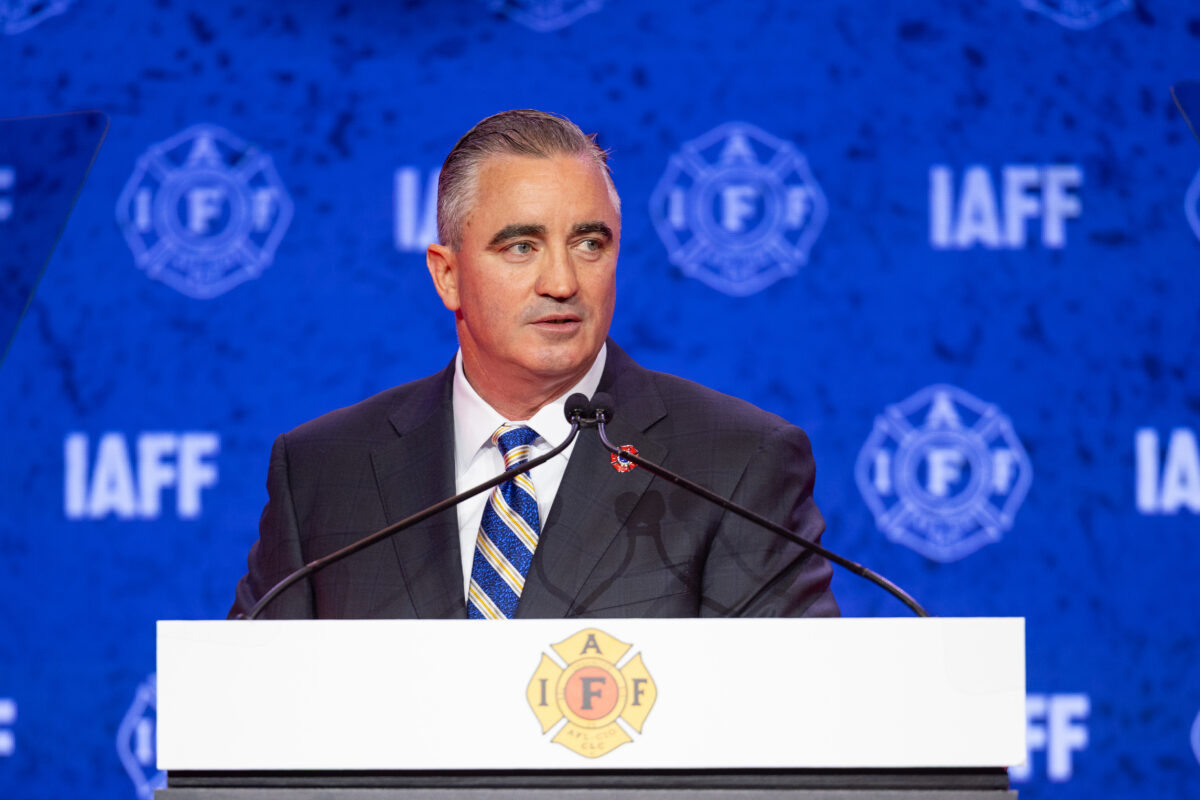
“All in is a promise we make, and it starts with the job,” General President Edward Kelly said during the 58th Convention Opening Ceremony.
That promise, to never stop fighting and never leave an IAFF member behind, was at the center of Kelly’s address.
“Firefighting is dangerous work. You can do everything right on this job and still get killed,” Kelly said. “But accepting those dangers never meant surrendering to them. Every risk, every threat, this union meets head on.”
Every risk, every threat, this union meets head on.
General President Edward Kelly
Advocating for IAFF members and their families
Kelly pointed to Julie Paidar’s fight to secure occupational cancer benefits as an example of being all in.
In 2020, Julie lost her husband, Saint Paul, MN Local 21 member Mike Paidar, to acute myeloid leukemia at age 53. Minnesota had never recognized occupational cancer as a line-of-duty death, and Julie and Local 21 fought for that recognition, winning it in 2021.
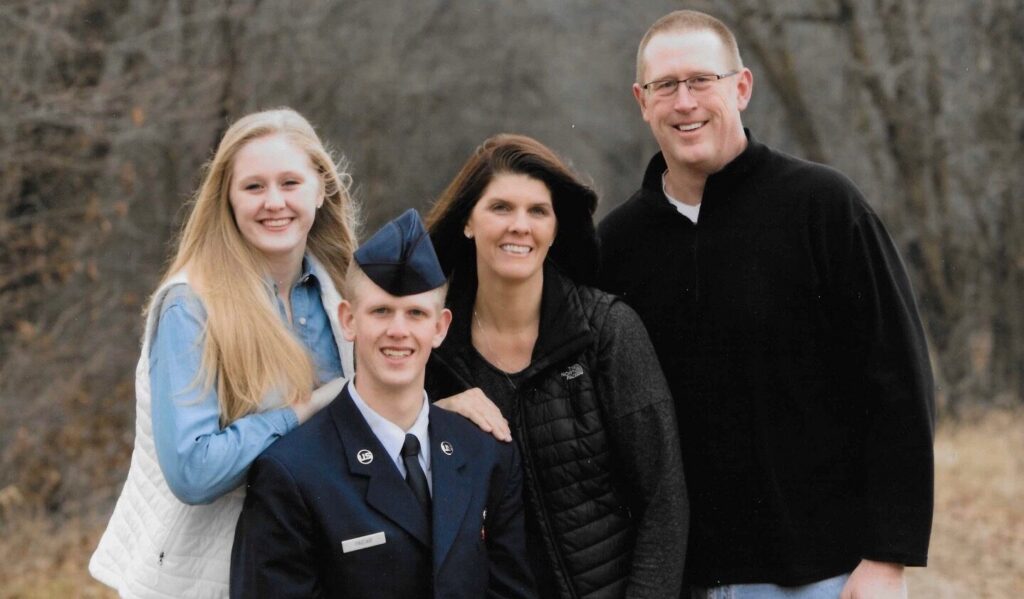
Working with the IAFF, Julie then took Mike’s story to Washington, collaborating with other fire fighter families to win federal recognition through the Honoring Our Fallen Heroes Act. Eligible families can now receive more than $461,000 in federal death and educational benefits.
“Julie helped change the law for families all across this country,” Kelly said. “The Paidar family never gave up, and neither did this union.”
That same commitment is behind the IAFF’s Medical Assistance Program, which has taken on more than 170 cases involving fire fighters and their families fighting for benefits they are owed.
The IAFF is also working with the federal government to fund IAFF-led cancer prevention work and participating in stakeholder conversations on the Canadian Fire Fighter Cancer Registry.
“Dr. Dan Whu, the IAFF’s Chief Medical Officer, has testified in more than a dozen states and in British Columbia, Manitoba, and Ontario to help pass presumptive laws that recognize various cancers, cardiac cases, and other illnesses on the job,” Kelly said.
In Austin, TX Local 975 members rallied behind Suzanne LaFollette after she was denied workers’ comp for stage-four uterine cancer because it was not listed as a presumptive occupational cancer in Texas. More than 100 members attended her hearing, while Whu testified about the connection between her cancer and 19 years on the job. The judge ruled in LaFollette’s favor.
“That win wasn’t just for her,” Kelly said. “It was for every woman coming after her.”
Kelly also credited IAFF Chief Science Advisor Dr. Derek Urwin and the IAFF’s growing investment in member-driven research, including work examining fire fighter exposures.
The IAFF’s influence is also growing in Canada.
In April this year, Kelly, General Secretary-Treasurer Frank Líma, District Vice Presidents Mike Carter, Fred LeBlanc, and Chris Ross, Assistant to the General President Carmen Santoro, along with Ottawa, ON Local 162 President Genna McMillan, and the MAP’s Neil McMillan met with Prime Minister Mark Carney to address concerns impacting Canadian fire fighters and paramedics.
The meeting highlighted the urgent need to increase Canada’s Memorial Grant Program, which has stayed unchanged since 2018 despite a 25 % inflation increase.
“When a fire fighter makes the ultimate sacrifice, the family gets a $300,000 memorial grant, but that grant hasn’t increased since 2018,” Kelly said. “We brought this directly to PM Carney, and he agreed it has to change.”
A union that fights
The IAFF has led efforts to remove PFAS from personal protective equipment, pushed for OSHA to adopt the Emergency Response Standard, and has continued fighting for adequate staffing.
“The most important thing we bring to a fire isn’t water or ladders. It’s fire fighters. Properly trained and equipped fire fighters,” Kelly said.
The union’s data-driven staffing work is helping Locals make that case. IAFF reports helped Los Angeles County, CA Local 1014 push for a fourth fire fighter on rigs. In Prince Edward Island, the 4 Fire Fighters 4 Your Safety campaign helped expose dangerous staffing levels. The fire chief who had dismissed the union’s warnings was later fired.
“When we fight, we win,” Kelly said. “The IAFF comes back, and we keep coming back until the city does the right thing by its fire fighters and the citizens we protect.”
The same approach is being used to defend collective bargaining. Since 2023, new agreements have covered roughly 8,000 IAFF members. Jackson, MS Local 87 won its first contract in 20 years; Irving, TX Local 2073 won its first contract; and Atlanta, GA Local 134 became only the third Local in Georgia to secure collective bargaining rights.
“When fire fighters have a seat at the table, we use it to negotiate safer working conditions,” Kelly said.
In Utah, IAFF members and other labor organizations collected more than 320,000 signatures in just 30 days after public-sector bargaining rights were stripped. Lawmakers ultimately repealed the ban, and the IAFF has chartered three new Locals in the state since.
“It doesn’t matter what your political party is,” Kelly said. “If you make a promise to the IAFF, you better keep it, or we’re coming for you.”
Delivering for IAFF members
Kelly also highlighted the Social Security Fairness Act, which eliminated the WEP and GPO provisions that reduced Social Security benefits for many public employees.
That approach has also included protecting collective bargaining rights during federal agency restructuring and securing the first increase in federal fire fighter uniform allowances in more than 20 years, from $800 to roughly $1,500.
U.S. Department of Labor Acting Secretary of Labor Keith Sonderling and Inspector General Anthony D’Esposito also addressed the convention, highlighting worker safety and overtime protections.
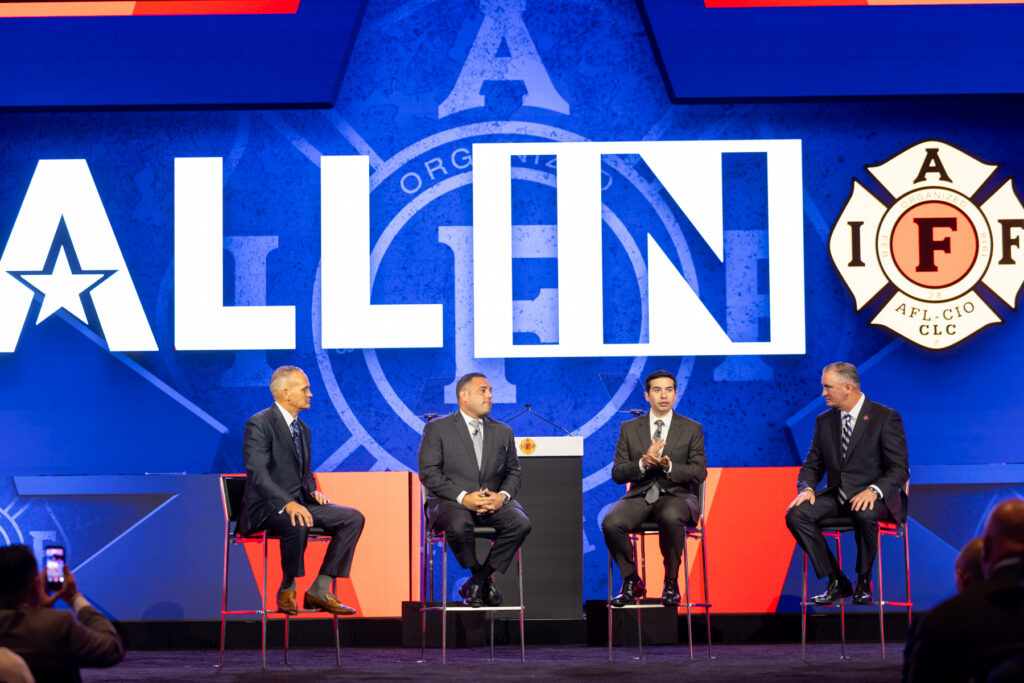
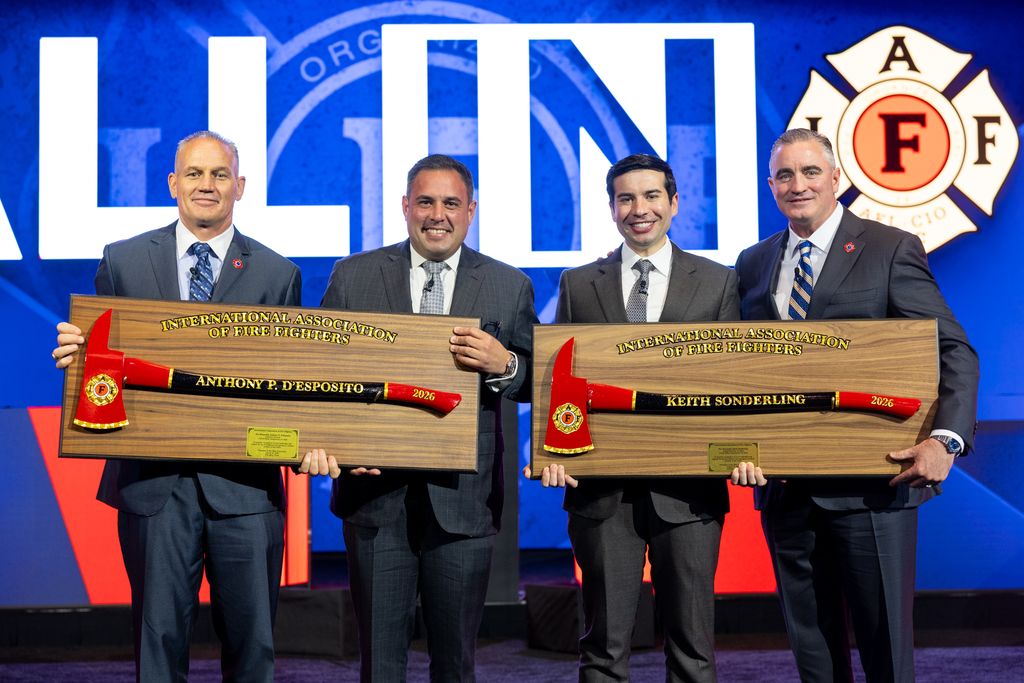
“There are two things I care about as [Acting] Secretary of Labor. Number one: making sure you return home safely every single night,” Sonderling said. “Number two, we will always protect overtime.”
The DOL is also working with the IAFF on its federally registered fire fighter apprenticeship program, creating more pathways into the profession. A pilot program is planned with Shreveport, LA Local 514.
Kelly said the union is investing not only in today’s fire fighters but in the future of the profession.
The IAFF Hazmat program has trained thousands of departments and federal agencies, including the U.S. Secret Service. An $8 million National Institutes of Health (NIOSH) grant, the largest in IAFF history, is supporting research into emerging hazards and a new fire fighter drone program.
But Kelly warned technology cannot replace people.
“We have to be careful that these new tools don’t come at the cost and expense of well-trained, properly equipped fire fighters,” he said.
The IAFF is also expanding its Responding to the Interface program, which prepares structural fire fighters for wildland-urban interface fires. As wildfires rage in parts of Canada, the IAFF is working with the Government of Canada to ensure fire fighter are ready to respond. The program has trained more than 1,000 Canadian fire fighters to operate safely and effectively in wildland-urban interface fires.
The union’s Strive for Excellence Summit brought more than 2,000 members together for more than 200 workshops and hands-on training, with more than one-third of attendees coming from the rank and file.
Fighting for public safety
In Canada, the IAFF took the issue of public safety to Parliament Hill.
Halifax, NS Local 268 members, along with Santoro, discussed the issue of safety directly with Justice Minister Sean Fraser.
Those efforts paid off, and in June, Parliament enacted Bill C-14 which requires judges to treat an assault on an on-duty fire fighter or paramedic as an aggravating factor at sentencing.
“Our members are getting assaulted on the job, and in many cities across North America, it’s getting worse,” Kelly said. “The law sends a clear message: assaults against our members are serious crimes that carry serious consequences.”
Our members are getting assaulted on the job, and in many cities across North America, it’s getting worse. The law sends a clear message: assaults against our members are serious crimes that carry serious consequences.
General President Edward Kelly
Kelly also addressed the ongoing fire apparatus crisis in the U.S. and Canada as private equity has driven up prices and wait times while putting public safety at risk.
“This is a public safety crisis driven by greed,” Kelly said. “We will do everything we can to see the industry held accountable.”
He also highlighted the IAFF’s Guardian Policy and legal work. Since the last convention, the IAFF legal team has recovered more than $4 million for members. Bexar County, TX Local 4978 member Keith Porter was fired after putting safety concerns in writing. With IAFF support, he returned to the job.
The union is also continuing its fight for the World Trade Center Health Program as the 25th anniversary of September 11 approaches.
“When we say Always remember, Never forget, we mean it,” Kelly said.
Kelly emphasized that the IAFF’s commitment to its members is evident in its growth, now surpassing 368,000 members, the highest in its history.
In Canada, Blood Tribe Emergency Services Association became the IAFF’s 200th Canadian Local and the first to represent a First Nation. Québec City voted in 2026 to reaffiliate with the IAFF by an 88 % margin, with many other new members joining across the U.S. and Canada.
“We are an investment in each other, and the return on that investment is the protection of our families,” Kelly said. “We’re not here to live in the past. We have a plan for the future. We’re here to be All In.”