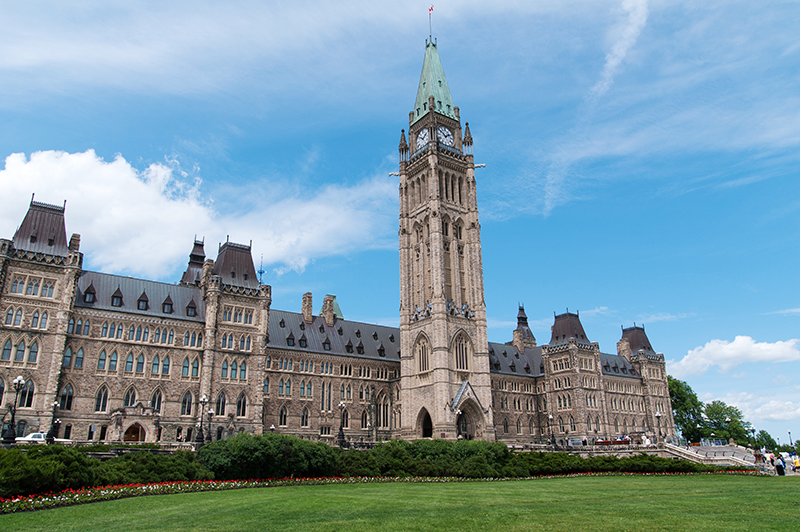
In a submission to the Canadian Government, the IAFF is calling for measures that would better support the families of fallen emergency responders, expand hazardous materials training and improve emergency preparedness across Canada.
The proposals are outlined in a May 22 pre-budget submission that members of Parliament will review ahead of recommendations for next federal budget, expected this fall.
Building on a key issue lobbied by delegates at the 33rd Canadian Legislative Conference in April, the IAFF is urging the federal government to increase the Memorial Grant Program for First Responders benefit from $300,000 to $375,000 to account for inflation, and to index it annually to the Consumer Price Index.
Established in 2018 following a 25-year effort by the IAFF, the Memorial Grant Program provides a tax-free, one-time payment to the families of fire fighters, paramedics, police officers and other public safety personnel who die in the line of duty. But the benefit amount has remained unchanged since the program’s creation, despite inflation rising by roughly 25 per cent over that period. As a result, the value of the benefit has steadily eroded and will continue to decline unless it is indexed.
“A line-of-duty death benefit is intended to provide financial stability at a moment of profound loss and to reflect the federal government’s commitment to those who have died in service to the public,” the IAFF submission states, noting that other federal benefits such as OAS/CPP and veterans’ benefits are indexed. “Allowing inflation to erode that commitment over time undermines both fairness and policy intent.”
The submission also highlights the IAFF’s proposed Enhanced Emergency Management Program (EEMP), designed to help communities better prepare for and respond to increasingly frequent disasters, including wildfires, earthquakes, and major transportation incidents.
With initial federal funding of $2.5 million, the EEMP would build on the IAFF’s existing HazMat and Responding to the Interface (RTI) programs to strengthen collaboration with at-risk communities, improve disaster preparedness, enhance mitigation and response capabilities.
These investments have made a real difference, but they need to keep pace with inflation and the changing challenges facing our members and the communities they protect.
IAFF prebudget submission to canadian government
The IAFF has proposed $4 million in federal funding in years two and three for training, delivery and review, with ongoing funding scalable to meet evolving emergency management needs.
The federal government’s Emergency Management Strategy for Canada outlines five priorities for improving disaster resilience by 2030, including enhanced collaboration, prevention, mitigation and disaster resilience.
“The EEMP is designed to help the government achieve these priorities,” the submission states. “Adopting the EEMP will equip the government with tools to enhance collaboration and resilience in disaster preparedness and response, leveraging the IAFF’s proven expertise as demonstrated by past and ongoing IAFF successes in related fields.”
The submission also calls on the Canadian Government to double funding for the IAFF’s Canadian HazMat & CBRNE Training Initiative to $1 million annually to address rising program costs, meet growing demand and expand access to underserved communities.
Since 2009, the federally funded program has trained more than 10,000 fire fighters and other emergency responders to a recognized level of HazMat response using IAFF instructors and curriculum. Courses, including train-the-trainer programs, are available in English and French and can be held in remote and Indigenous communities.
General President Edward Kelly said the proposals build on successful programs that should evolve to meet changing needs and growing risks.
“We’re grateful to the Canadian Government for the Memorial Grant Program and for partnering with the IAFF on HazMat and RTI training,” he said. “These investments have made a real difference, but they need to keep pace with inflation and the changing challenges facing our members and the communities they protect.”