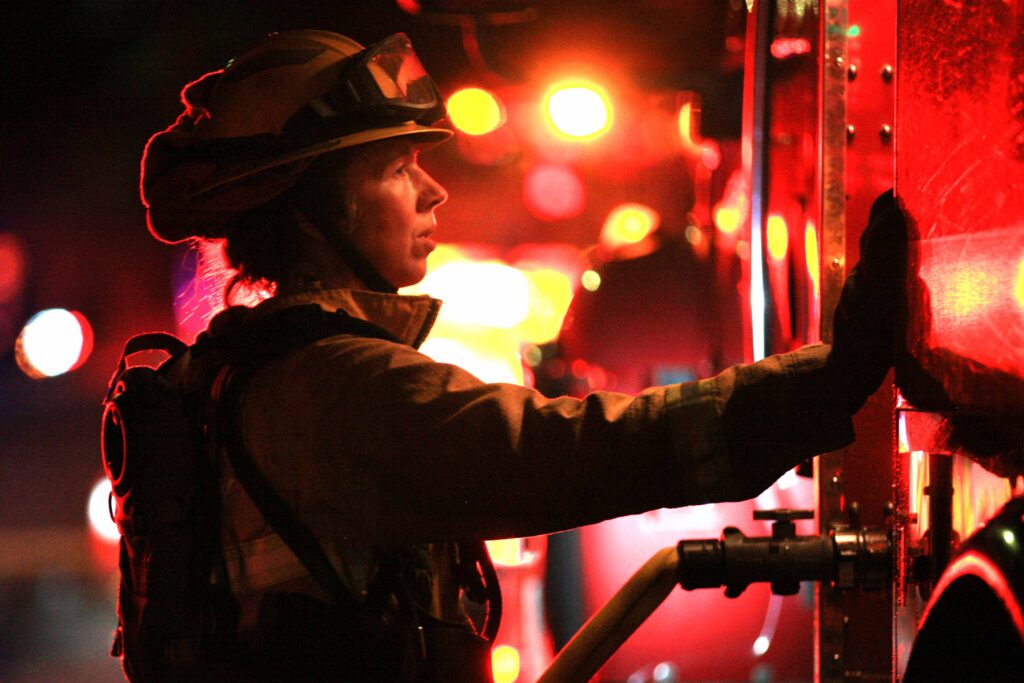
Ill-fitting turnout gear can restrict movement, increase fatigue, and reduce protection on the fireground. For many women in the fire service, it is also a persistent challenge.
Research shows about 80% of women fire fighters report ill-fitting gear – roughly four times the rate reported by men – prompting researchers to study how better design and fit could improve safety and performance.
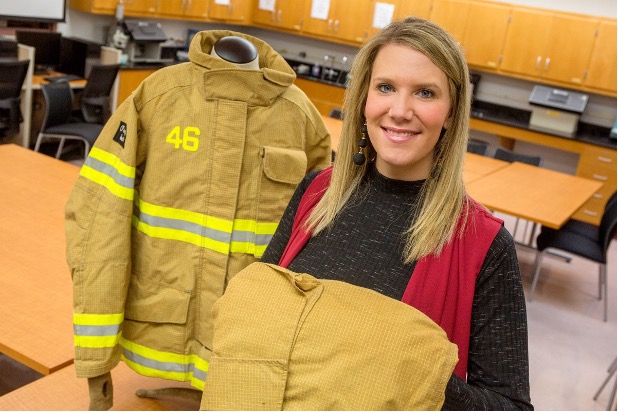
At Florida State University, Dr. Meredith McQuerry is leading a multi-year, FEMA-funded research program to improve PPE fit, design, and performance for women in the fire service. That work, conducted in collaboration with the Fire Protection Research Foundation (FPRF), the research affiliate of NFPA, evaluates and improves the fit and mobility of structural turnout and wildland PPE for female fire fighters.
The study is led by McQuerry (FSU) and Dr. Cassandra Kwon (North Carolina State University), who are collecting anthropometric body measurements from female fire fighters nationwide to better align PPE design with real-world dimensions and improve safety and performance.
We interviewed McQuerry about the research and why it matters:
IAFF: Why is it so important to raise awareness about PPE fit, especially for women in the fire service?
McQuerry: I’ve studied firefighting PPE for over 15 years, focusing on physiological comfort, mobility, and heat stress. Through fire fighter collaboration and human trials with Dr. Kwon, we identified a major gap: very limited data and inclusion of women in PPE research.
About 80% of women report ill-fitting gear – roughly four times higher than men. That matters because fit directly impacts heat strain, fatigue, and injury risk, while also affecting mobility and long-term health outcomes.
We’re also working through FEMA-funded research with the University of Arizona and Dr. Jeff Burgess to better understand how PPE fit may relate to exposure pathways and cancer risk. Fit impacts everything – from chemical protection to ergonomic safety – which is why it has to be addressed first.
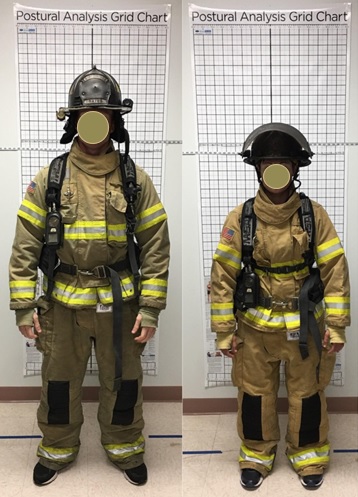
Photo courtesy: Dr. Meredith McQuerry
Q: What are some of the most common fit problems fire fighters are experiencing?
McQuerry: When we began this research in 2018, we conducted a nationwide survey with more than 2,000 female fire fighter respondents to better understand the issue.
We’ve primarily focused on turnout coats and pants, as well as wildland shirts and pants, though we’re expanding into other equipment areas.
A consistent challenge is “compromised fit” – women are often forced to choose between gear that fits in one area but is restrictive in another, or gear that is sized up overall but oversized in key regions.
For example, if the chest fits, the rest of the garment may be too large; if the overall size is correct, critical areas may be too tight. This becomes especially problematic during overhead tasks, climbing, and overhaul, where bulk in the shoulders, neck, and upper torso restricts movement.
In one trial, a female fire fighter wore a male-cut garment and the collar sat up near her face, covering her mouth and a portion of her nose, clearly showing how disproportionate fit can be.
Overall, our data shows women in the fire service have significantly different body shapes and measurements compared to the general female population. That finding reinforces the need for PPE designed specifically for female fire fighters, using appropriate patterns and sizing systems rather than adapting male-based designs.
Q: What can departments and fire fighters do to advocate for better-fitting PPE?
McQuerry: When we started this work nearly a decade ago, only a couple of manufacturers offered women’s PPE. Today, most manufacturers offer some form of women’s-cut gear, which is a major step forward.
But availability alone isn’t enough. Departments need to actively support both fit options and ensure fire fighters can choose what works best for them. Fit preference isn’t one-size-fits-all – some men also prefer women’s-cut gear due to differences in hip shape and mobility.
Measurement practices are also critical. We’ve seen cases where entire departments received gear that was 4-6 inches too long due to incorrect inseam measurements. Whoever is taking those measurements – department staff or vendor representatives – must be properly trained and aligned with manufacturer standards.
The key is simple: provide options, ensure proper fit, and make sure the data being collected is accurate.
Q: What is your ultimate goal for this work?
McQuerry: My doctoral work more than a decade ago focused on modernizing the turnout suit, with studies showing meaningful improvements, including reductions in core temperature of up to about 1.5°C. But those changes also required significant adjustments to training and operations.
Since then, the focus has shifted toward smaller, incremental improvements that move the needle more carefully, balancing thermal protection, physiological comfort, ergonomic mobility, and particulate protection without creating unintended consequences elsewhere.
We continue this work through NFPA committees, particularly 1970 and 1950, contributing to expanded sizing discussions, including women’s fit considerations in wildland and structural gear, and supporting more flexible sizing systems that allow for innovation.
A major focus now is translating research into practical tools, including developing a fit function analysis protocol designed to help quantify PPE fit during fire fighter sizing and provide departments with simple, usable data – ultimately with the goal of informing future NFPA standards.
The emphasis is always on real-world impact: practical, data-driven solutions that improve PPE fit, performance, and fire fighter safety.