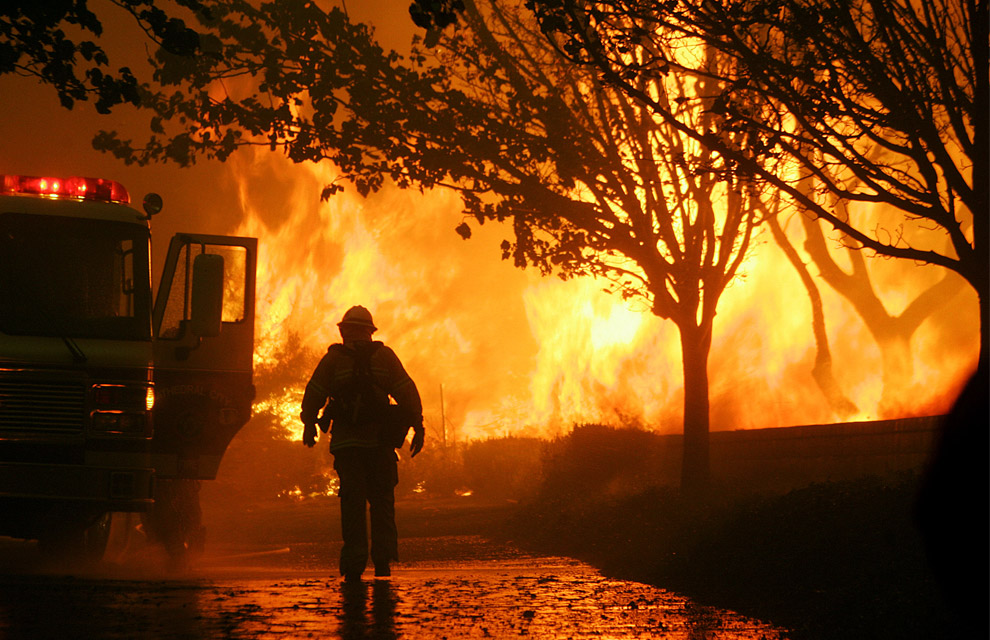
With wildland crews and equipment stretched thin, municipal fire departments are increasingly being called to help fight wildfires threatening populated areas.
Canada has recorded over 4,280 wildfires as of July 30, burning over 3 million hectares (or about 7.4 million acres) across the country. The most intense activity is concentrated in the western and northern regions. But no area is immune, as fires have been recorded in nine of 10 provinces and all three territories.
In the United States, more than 43,000 wildfires have burned over 4.6 million acres. The National Interagency Fire Center, has raised the National Preparedness Level to 5, the highest possible stage of response. It means that nationwide resources are heavily committed, and several regions are actively competing for critical personnel and equipment.
That strain is already drawing structural fire-service resources into wildfires at scale. In Oregon, where the nation’s four largest active wildfires were burning as of July 29, the state fire marshal had mobilized 33 task forces and six strike teams. Twelve additional teams from California and Washington were supporting the response.
“With dry conditions driving the escalation of wildfire activity across the United States and Canada, these numbers are likely to increase, not decrease,” IAFF Wildfire/Urban-Interface Fire Programs Director Joseph Ten Eyck said. “You need fire fighters to fight fires. And municipal fire fighters are an excellent resource. But most municipal departments don’t provide the needed training.”
A recent National Fire Protection Association survey showed that 87% of departments report that fighting fires in the interface is part of their duties. But two-thirds of those departments have no formal interface training.
Municipal fire departments’ escalating role
Although the West continues to experience many of the largest and most destructive wildfires, dangerous fire conditions affect communities across the United States. Recent fires and drought conditions in New Jersey and North Carolina underscore that the threat extends beyond the regions most closely associated with wildfire.
Municipal departments play a critical role when wildfires enter the wildland-urban interface, or WUI, where development meets or intermingles with undeveloped vegetation. In these areas, fire fighters may be called to defend neighborhoods and infrastructure while operating in conditions that differ significantly from a structure fire.
“Fire fighters are all-hazards emergency responders, and we do not get to decide what calls we go on. That includes wildfires, so we must be prepared,” said Blake Miller, a Scottsdale, AZ Local 5050 member and instructor with the IAFF’s Responding to the Interface (RTI) program. “While, statistically, most departments do not provide training, we are seeing an uptick in requests for the Responding to the Urban Interface (RTI) training provided by the IAFF.”
RTI includes introductory and advanced courses that prepare structure fire fighters to use available personnel, apparatus, and equipment safely and effectively during interface fires.
Fire fighters are all-hazards emergency responders, and we do not get to decide what calls we go on. That includes wildfires, so we must be prepared.
Scottsdale, AZ Local 5050 member and RTI instructor Blake Miller
Preparing Hawaii’s fire fighters
The IAFF is preparing to conduct its final round of RTI training in Maui this October. The program is giving members the skills to handle incidents ranging from smaller wildfires to large-scale emergencies like the wind-driven 2023 wildfires that killed more than 100 people and devastated large portions of the island.
“Once we complete this next training, 100 Hawaii fire fighters will have completed this course. Our next objective is to take what we have learned and train responders throughout the state in RTI protocols,” said Timothy Herrick, Hawaiian Island Local 1463 member and RTI trainer. “What we have on the island is all we will get for days, so we have to be ready.”
RTI instructor and Colorado Springs, CO Local 5 member Justin White said the training helps fire fighters understand how weather affects an incident, adapt structural firefighting resources for use in the interface, and operate effectively when mutual aid may be days away. Because RTI in Hawaii is using a train-the-trainer model, participants can also bring the curriculum back to their departments and prepare additional members.
Training expands across Canada
In Canada, provincial and territorial wildland fire crews typically manage fires outside populated areas.
Although the country’s most intense wildfire activity has historically occurred in the West and North, other regions are also facing increased risks.
Ontario is currently experiencing a high volume of wildfires. Those fires are predominantly in rural areas handled by provincial wildland fire fighters. But if the fires start threatening communities, municipal fire departments will be called in to support the response.
Should that happen, Thunder Bay, ON Local 193 will likely be the first call. And its members are prepared.
“I came to this department from a wildland firefighting background about 10 years ago,” said Nick Pettigrew, Local 193 member and RTI instructor. “But not everyone in my department had the same background. So, a couple of years ago, I took the trainer course so I could help bridge any gaps.”
The Canadian federal government launched a pilot program with the IAFF to fund RTI training in 2023. Through the initial federally funded pilot, 350 Canadian fire fighters completed RTI training in late 2023 and early 2024. The Canadian government subsequently expanded the initiative to train additional fire fighters across the country. IAFF 6th District Vice President Mike Carter oversees the program in Canada.
“Wildfires are a growing issue across Canada, and that means we need more resources so that we can respond to these fires faster. And trained municipal fire fighters are a critical part of those resources,” Carter said. “Dealing with interface wildfires is dangerous and unpredictable due to the topography, vegetation fuel sources, variable hazards, winds, and dry heat. The RTI program enhances public and responder safety in the interface.”
Wildfires are a growing issue across Canada, and that means we need more resources so that we can respond to these fires faster. And trained municipal fire fighters are a critical part of those resources.
6th District Vice President Mike Carter
Glenn Sullivan, a Fredericton, NB Local 1053 member and instructor, experienced the need for that training firsthand.
“I was being dispatched with my crew to these events before I was fully trained in responding to the interface,” Sullivan said. “I sought out this training so that, as an incident commander, I fully understood what I was asking everyone under my command to do.”
Why are there more wildfires?
Drought and dry vegetation are increasing wildfire risks, while continued development in the WUI puts more people, homes, and infrastructure in harm’s way.
Currently, drought-like conditions are plaguing many areas of North America. In fact, Fredericton, N.B., just emerged from its second-driest winter on record. The region received less snowpack, depleting the soil of the moisture and saturation it needs to ward off wildfires.
“With saturation levels down to 20%, the amount of dry fuels has increased,” Sullivan said. “When some hear 20% saturation, they think, ‘Oh, that’s not too bad.’ But it is when you consider that the lumber you get at the hardware store is just below that, at 19%. Ideally, you want it be more like 60-70%.”
Heat waves can cause wildfire conditions to deteriorate quickly by drying vegetation and producing hotter nights, limiting a critical period when fire fighters can make progress containing a fire. Recent research found that just under half of the acreage burned during warm-season months from 2001 to 2024 burned during or immediately after a heat wave.
Relief may be coming in the form of new wildfire prevention policy. In California, those policies have allowed wildfire reduction programs, including fuel-reduction projects, to be performed on hundreds of thousands of acres each year since 2024.
“The path forward is to continue to fight for legislation and policy that will increase resources and put mechanisms in place to get those resources on the fire as quickly as possible. Trained municipal fire fighters will be key,” Ten Eyck said.
Learn more about the RTI training provided by the IAFF.