Fire fighter cancer risks are increasingly well documented, but for women in the fire service, important questions about occupational exposure and reproductive health remain unanswered.
Researchers and fire service leaders say closing those gaps is critical to strengthening protections on the job.
Women make up about 9% of the fire service, yet they remain significantly underrepresented in fire fighter health research – particularly in studies examining reproductive health and long-term health outcomes tied to occupational exposure.
“We know now that there are adverse health outcomes associated with the unique risks of firefighting, in general,” said Dani Landholm, a member of Omaha, NE Local 385 and the IAFF Female Health and Safety Committee.
For Landholm and the committee, that reality is driving efforts to turn research into practical guidance members can use inside fire stations and while responding to calls.
“Outreach and education are a huge piece of our movement in the committee,” she said. “How do we teach people about how to deal with the risks?”
Outreach and education are a huge piece of our movement in the committee.
omaha, ne local 385 & iaff female health and safety committee member Dani Landholm
Occupational cancer is the leading cause of line-of-duty death among fire fighters, and firefighting is classified by the International Agency for Research on Cancer (IARC) as a Group 1 carcinogen. That designation has helped fuel major national research efforts supported by the IAFF and federal partners, including the National Firefighter Registry for Cancer, a long-term study examining occupational exposure and cancer outcomes among fire fighters.
“This is the largest cohort study of fire fighters ever,” said Dr. Brittany Hollerbach, Associate Scientist and Deputy Director of the Center for Fire, Rescue, and EMS Health Research.
“They’ll be able to compare fire fighters who develop cancer with those who don’t and examine lifestyle and occupational factors.”
While cancer risks in the fire service have become better understood over time, researchers say significant gaps remain in understanding how those risks affect women fire fighters.
Much of what is known comes from a growing body of research led by scientists,including Hollerbach and Dr. Sara Jahnke, a senior scientist with the Center for Fire, Rescue & EMS Health Research at the National Development & Research Institutes.
Jahnke has contributed to large studies surveying more than 1,800 U.S. women fire fighters to look at a number of experiences and health impacts, including reproductive health.
Across these studies, researchers found that women fire fighters experienced elevated miscarriage risk compared to the general population, with estimates ranging from roughly 1.5 to over 2 times higher.
They also observed higher rates of preterm birth among women fire fighters.
Presumptive cancer laws and research gaps
As more women enter the fire service and research on occupational exposure expands, advocates continue pushing for presumptive laws that better reflect the full range of cancers linked to the job, including female reproductive cancers.
Those questions have real-world consequences for members navigating diagnoses and workers’ compensation claims.
Austin, TX Local 975 member Suzanne LaFollette experienced that firsthand after being diagnosed with Stage 4 uterine (endometrial) cancer. Her workers’ compensation claim was initially denied before she later won a significant appeal with support from the IAFF’s Medical Assistance Program.
Her case could help inform future occupational cancer claims involving women fire fighters and may shape how occupational cancers affecting women are considered moving forward.
While studies are beginning to identify trends, researchers say more work remains.
“Reproductive health is somewhat more challenging,” Hollerbach said. “This is due to numerous reasons. First, it is under-researched.”
Reproductive health is somewhat more challenging. This is due to numerous reasons. First, it is under-researched.
Dr. Brittany hollerbach, Associate Scientist and Deputy Director of the Center for Fire, Rescue, and EMS Health Research with ndri-usa
Landholm says one of the biggest barriers is the number of participants.
“You can visit a city and find hundreds of male fire fighters, but only about 20 or 30 women,” said Landholm. “This means you’ll need to travel to 10 different cities to gather the same number of women for studies.”
That smaller participant pool makes long-term research more difficult, especially when scientists are trying to study how exposure affects women across different stages of life and career.
Translating science into policy
For the Female Health and Safety Committee, the focus has shifted beyond awareness and toward helping departments put evolving science into practice.
At the IAFF Strive for Excellence Summit in Las Vegas this March, Landholm and retired Fairfax, VA Local 2068 Fire fighter/Paramedic Stephanie White led a workshop focused on reproductive health policy in the fire service.
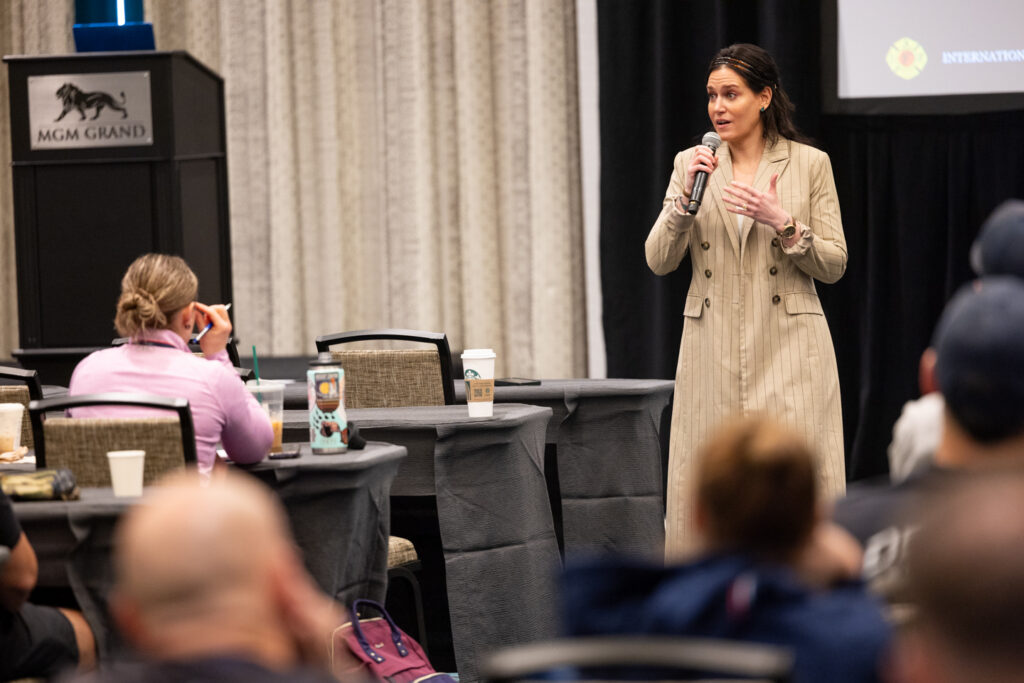
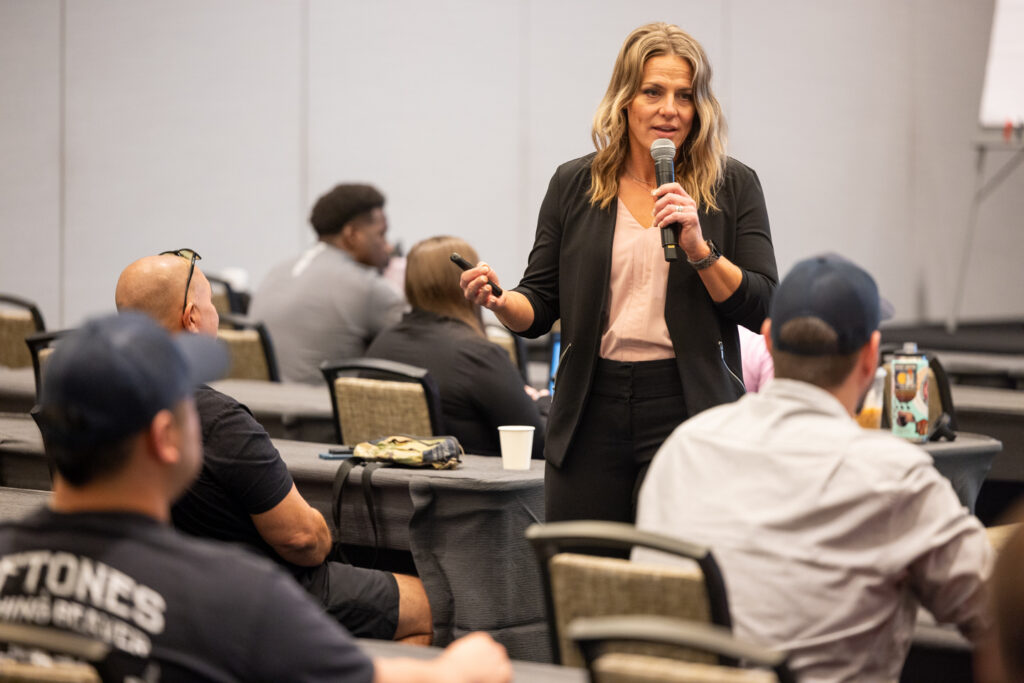
“Often, there are policies out there that may just regurgitate the law, and they don’t provide much direction for supervisors,” Landholm said. “That opens up opportunities for personal belief system translations and cultural aspects that can lead to inconsistent practices.”
Landholm said the committee is working to align guidance around risk reduction measures related to reproductive health, as well as broader issues like PPE fit, maternity accommodations, lactation support, and pregnancy policies that vary between departments.
FEMA-funded fire fighter health research, including the Fire Fighter Cancer Cohort Study (FFCCS), is helping expand long-term understanding of occupational exposures and health outcomes in the fire service – including issues like PPE fit, sleep, lactation, and reproductive health.
“We don’t look at our members and just say, ‘Sorry you have cancer,’” Landholm said. “We say, ‘How do we stop this from happening, and how do we fight it?’ If the way my body is built increases my exposure risk, then how do we fix that? That’s why we’re talking about women’s gear fitting, policy gaps, education, and access.
“At the end of the day, it’s about making sure risk reduction is distributed evenly across the fire service.”