Twenty-five years after 9/11, the World Trade Center is still claiming lives.
More than 600 fire fighters have died from WTC-related diseases, nearly twice the number that were killed on Sept.11, 2001. Thousands of responders and survivors continue to live with cancers, respiratory diseases, and other serious illnesses linked to the attack.
In the days and weeks after the attack, fire fighters from across the United States and Canada traveled to Ground Zero to assist with the search and recovery effort. Few understood that the toxic mixture of dust and debris blanketing lower Manhattan could bring devastating health consequences in the years to come.
Yet, even as they continued getting sick, fire fighters faced resistance to securing federal support for medical monitoring and treatment. So they set out to prove what they could see was happening.
Their efforts ultimately led to the creation of the World Trade Center Health Program (WTCHP), which today provides medical monitoring and treatment to responders and survivors in all 50 states.
But establishing – and funding – this critical program was anything but easy.
“Fire fighters – and countless others – answered the call on 9/11 without hesitation,” General President Edward Kelly said. “Twenty-five years later, people are still getting sick because of their service. We all have a duty to make sure they get the care they need.”


Fire fighters – and countless others – answered the call on 9/11 without hesitation. Twenty-five years later, people are still getting sick because of their service. We all have a duty to make sure they get the care they need.
General President Edward Kelly
The program 9/11 made necessary
As the evidence connecting Ground Zero exposures to long-term health effects mounted, fire fighters and their allies took their research, data, and fight to Capitol Hill.
“Too many politicians were not waking up to the fact that this was an attack on America, and the federal government needed to step up and make sure that our members would get the health treatment they needed,” said 1st District Vice President James Slevin.
The evidence fire fighters brought to Washington was possible in part because the FDNY had established health baselines for its members before 9/11.
Annual medical exams included pulmonary function tests, giving researchers data from before and after the attacks. According to FDNY Chief Medical Officer Dr. David Prezant, members ordinarily experienced an annual decline of about 30 milliliters in lung function from normal aging. In the six to 12 months after 9/11, the average decline was 372 milliliters – more than 12 times the expected loss.
Some members of Congress initially argued that the respiratory symptoms would resolve. But in 2006, FDNY researchers reported that most affected members had not recovered the lung function they lost.
The findings changed the debate, Prezant said. The question was no longer whether the health effects were real and lasting, but how the federal government would fund the care responders needed.
Congress passed the James Zadroga 9/11 Health and Compensation Act in 2010. President Barack Obama signed it into law in 2011, creating the WTCHP to provide medical monitoring and treatment for those affected by 9/11-related exposures.
The federal program followed years of work by the IAFF, its New York City Locals, medical experts, labor partners, and other advocates. Before Zadroga, they returned to Congress annually to secure funding for monitoring and treatment.
The IAFF also used its national reach to build support beyond New York. When votes were needed from lawmakers in other parts of the country, the IAFF worked through state and Local leaders to make clear that the attacks – and the responsibility to those exposed – belonged to the entire nation.
“We needed to make sure that not just fire fighters were protected, but people who worked the pile – construction workers, law enforcement, anybody who really had contact and exposure on that terrible day and thereafter during the recovery,” former Assistant to the General President for Government Affairs Kevin O’Connor said.


Today, the program serves nearly 150,000 people nationwide.
Health monitoring became increasingly important as researchers learned more about the long-term health impacts of 9/11. And as the science evolved, so did the WTCHP.
“When the original bill was passed, cancer was not covered,” said Ben Chevat, former chief of staff to then-Rep. Carolyn Maloney (D-NY), who now serves as executive director of 9/11 Health Watch and Citizens for the Extension of the James Zadroga Act.
Today, the federal program covers a wide range of 9/11-related illnesses, including most cancers, aerodigestive disorders, acute traumatic injuries, mental health conditions, and musculoskeletal disorders. Expanded coverage, coupled with continued monitoring, has helped health experts identify illnesses earlier and improve health outcomes.
The results demonstrate the value of connecting continued monitoring with comprehensive treatment.
According to a new FDNY health report, 86% of members of the FDNY World Trade Center Health Program diagnosed with cancer survived at least five years after diagnosis. The comparable rate among New York state residents was 63%.
Prezant said the analysis compared patients of similar ages diagnosed with the same types of cancer. He attributes the difference to a system that monitors members regularly, identifies illnesses earlier, and connects patients with treatment sooner.
The program covers monitoring and treatment without copays or deductibles. Case managers help members schedule appointments, obtain medications, and navigate their care. For FDNY members receiving chemotherapy, a family assistance program can also provide transportation to and from treatment.
“That’s what makes the difference, this holistic approach,” Prezant said.
The creation of the WTCHP has helped transform care for thousands of responders and survivors. But it was only part of the fight.
Funding the program would be another battle – one that would last more than a decade.
The fight to keep a promise
With the Zadroga Act signed into law, many thought the issue was settled. But as enrollment and costs continued to rise, some lawmakers began questioning the program’s growing funding needs. The IAFF, its affiliates, medical experts, and advocates found themselves back in the nation’s capital.
For members already undergoing treatment, the possibility of a funding shortfall was not an abstract budget debate.
Uniformed Fire Officers Association (UFOA) Local 854 President Jim Brosi described the “trepidation in our members” when they heard the program could run short of money. Some were in the middle of cancer treatment and did not know whether their next authorization would come through.
The uncertainty grew as more responders and survivors enrolled, and the cost of new treatments increased. Funding the program meant ensuring that members would not lose access to care after beginning it.
“Fire fighters really lead the way in terms of organizing,” said Chevat.
Fire fighters really lead the way in terms of organizing.
ben chevat, executive director of 9/11 Health Watch and Citizens for the Extension of the James Zadroga Act


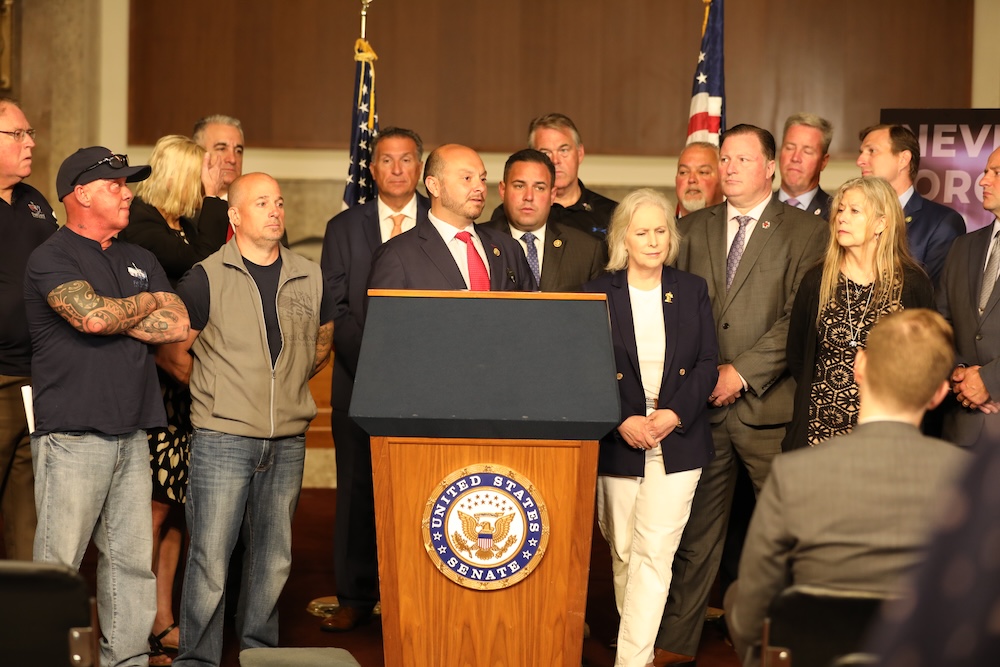
Working alongside the UFOA and the Uniformed Firefighters Association (UFA) Local 94, the IAFF turned what some called a “New York issue” into a national priority. Fire fighters from across the U.S. traveled to Washington, shared their experiences with lawmakers, and pushed both parties to provide long-term funding.
“This is not a New York problem. This is a nationwide problem. This was a nationwide promise,” said Brosi.
That advocacy helped build a bipartisan coalition committed to protecting long-term funding for the WTCHP.
“The IAFF and fire fighters from across the country have been relentless advocates for this program, coming to Washington year after year and making sure Congress never loses sight of the people behind this fight,” said Rep. Andrew Garbarino (R-NY), who played a key role in building support for program funding in the House.
Congress reauthorized the WTCHP for 75 years in 2015. But with enrollment and costs continually increasing, it became clear that a more fundamental challenge remained: fixing the program’s underlying funding formula.
“We were very concerned that as we get further and further away from 9/11, the focus and the commitment might [fade],” said Chevat.
In 2026, Congress passed bipartisan legislation to correct the WTCHP’s funding formula, ensuring it keeps pace with enrollment through 2040. President Donald Trump signed the bill into law on Feb. 3, 2026.
“I am so proud to have worked alongside tireless advocates, including the members of the IAFF, to fully fund this program, and I will keep fighting to make sure our heroes get the care they deserve – not just in moments of crisis, but for life,” said Sen. Kirsten Gillibrand (D-NY), an early and vocal champion of the program and the funding correction.
After decades of work, the WTCHP has become a long-term commitment to the responders and survivors living with the consequences of Sept. 11, 2001.
The lessons that changed a nation
The World Trade Center Health Program established a model for protecting people after a large-scale toxic exposure: Document what responders encountered, compare their health against reliable baselines, monitor them for illnesses that may take years to develop, and connect them with treatment.
“It’s critically important to provide post-exposure medical and mental health screening [and] continuous, regularly scheduled monitoring exams,” Prezant said. “And if significant problems are identified, coupling monitoring with treatment.”
That approach has protected thousands of responders and survivors. It has also changed what fire fighters and their advocates expect after other disasters involving toxic exposures.
“I think the World Trade Center Health Program is a model for how national health care should be,” Prezant said.


I think the World Trade Center Health Program is a model for how national health care should be.
Dr. David Prezant, fdny chief medical officer
Twenty-five years after 9/11, the program represents a promise that extends beyond any one disaster. When people are exposed while responding to an attack or serving their community, the government’s responsibility to them does not end when the immediate response does.
For fire fighters, that commitment is also essential to preparing for whatever comes next.
As Slevin put it, “They have to know that the government has their back.”