Calgary, AB Local 255 is celebrating a hard-fought victory for fire fighter and public safety after municipal councillors approved the creation of a Fire Services Committee for the fast-growing city.
The committee, a longtime goal of the union, is the first of its kind in Canada and will create a direct link between the fire service and City Hall, helping ensure fire department needs are heard by decision-makers.
Citing years of advocacy, Local 255 President Jamie Blayney called council’s approval of the Fire Service Committee “a monumental win for us” and looks forward to helping the city shape the initiative over the coming months.
The Calgary Fire Department is part of a larger city department called Community Services which also oversees housing, parks and recreation and other services, with a shared budget. Local 255 says several layers of bureaucracy separate the fire department from City Hall, often leaving fire service needs unaddressed while funding that could be used to improve fire department resources is redirected elsewhere. As a result, the fire department has struggled to keep pace with the city’s rapid expansion and population growth.
“We’re like a lot of cities. We’re behind on halls, we’re behind on trucks and we’re behind on staffing,” Blayney said. “We’re racing toward two million people and we just haven’t been able to keep up the pace.”
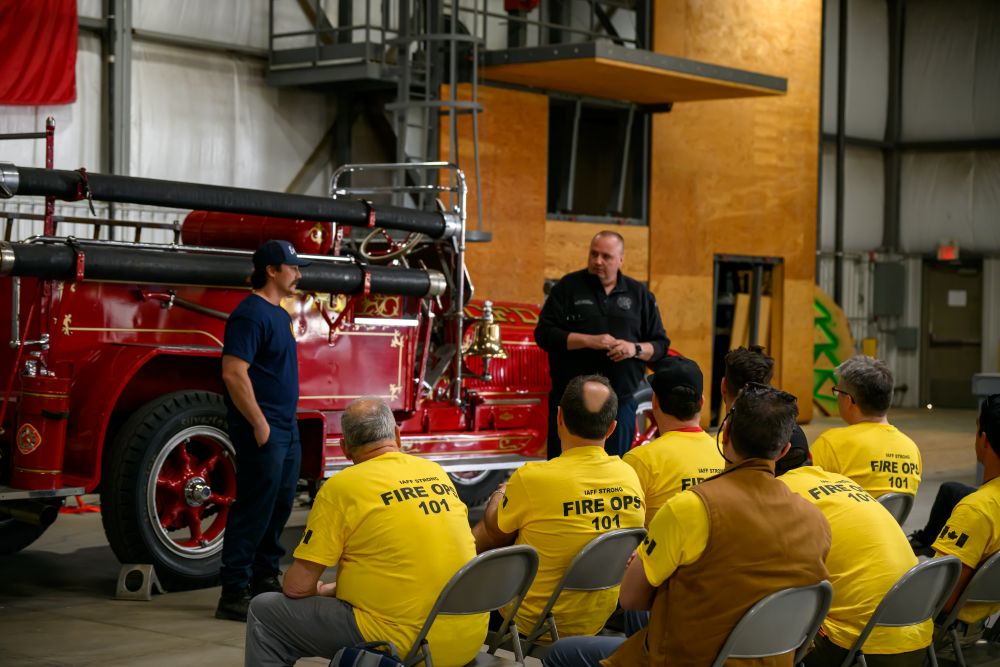
Local 255 had pushed for the initiative for over a decade in a focused political action effort. The unanimous May 27 council vote came just three weeks after nine municipal councillors got a hands-on firefighting experience through a May 8 IAFF FIRE OPS 101 event, with another 13 councillors and city staff on hand to observe.
Participants took part in a series of scenarios, including a medical response, a motor vehicle collision, an aquatic rescue, and a structure fire, giving elected officials a firsthand look at the challenges members face on the job.
Blayney said the Local’s relationship with council is at a high point, and said having the FIRE OPS 101 event prior to the council vote had an impact.


“This essentially became a slam dunk once they saw what we do every day,” Blayney said.
Calgary has a population of around 1.7 million and continues to grow at a rate of up to 4% annually. In just the past five years, fire department call volumes have increased around 50%, driven by population growth, urban sprawl, medical emergencies and drug overdoses.
The city set a seven-minute target for fire department response times, but the average is currently 7:48, which is well above the NFPA standard for urban fire departments.
“The Fire Services Committee could look at an NFPA study and say that the city of Calgary should meet NFPA standards. They can actually make recommendations, and they can drive the budget as well,” Blayney says.
The city is currently developing terms of reference for the Fire Services Committee, may ultimately resemble the Calgary Police Commission, which has two councilors and 10 community members.
Blayney said there is currently no plan for union representation, something he hopes will be reconsidered. He would also like to see retired fire fighters serve on the committee.
6th District Vice President Mike Carter, a Calgary fire fighter and former Local 255 president, started the conversation about a body such as a fire commission in Calgary in 2018 after witnessing the challenges of the bureaucracy and their impact on the fire service.
The Fire Services Committee could look at an NFPA study and say that the city of Calgary should meet NFPA standards. They can actually make recommendations, and they can drive the budget as well.
Local 255 President Jamie Blayney
He praised the city’s decision to move ahead with a Fire Service Committee and called it a welcome precedent that other Canadian cities should look at.
“It’s certainly a step in the right direction to make sure decision makers have the autonomy to make appropriate decisions for the safety of their citizens and fire fighters” Carter said.
While supporting the committee, Carter agreed it would be stronger with union representation.
“They need to hear from all people who are involved to make sure they have the best information,” he said. “When you’re missing important stakeholders at the table, you don’t make as strong a decision.”