With the province refusing to back down on its controversial move to allow single-exit stairways in residential buildings, British Columbia IAFF affiliates are taking the fight to municipal councils – and winning.
In response to advocacy from IAFF affiliate leaders and fire chiefs, West Kelowna prohibited single-exit stairways, while Vernon approved a two-year pause. Vancouver amended its building bylaw to move the single staircase outside of the building and strictly limit how many people can live on upper floors. The issue is also on the radar in Burnaby, Surrey, Victoria and Langley Township.
How B.C. got here
In August 2024, despite strong opposition from the IAFF, fire chiefs and other stakeholders, the province amended the BC Building Code to allow single-exit stairways in new residential buildings up to six storeys. The change, driven by a coalition of housing and design advocates, bypassed the rigors and oversight of the usual code development process.
Across Canada and the U.S., builders and developers are pushing to relax building codes to permit a single stairway in new midrise residential buildings, framing it as a housing affordability measure.
The IAFF, fire chiefs associations and other stakeholders strongly oppose the concept. With only one stairway, fire fighters using stairwells to reach a fire will be competing for space with occupants trying to escape – putting both at risk.
British Columbia Professional Fire Fighters Association (BCPFFA) President Todd Schierling said with the province holding firm, the municipal level is where the fight moves next.
“That is our path, to now navigate through municipal government. So, we’ll fight it from the bottom up,” Schierling said. “We’ve thrown everything we can at the provincial government and provided all the evidence-based papers, and it’s just bouncing off the wall. So, we have to educate mayors and councils. Ultimately, they’re the decision-makers to protect their own cities and their fire fighters.”
Schierling added that affiliates have an opening to make single-exit buildings an election issue ahead of municipal elections taking place Oct. 17.
Making the danger real
Using resources from the IAFF, the BCPFFA has educated municipal leaders across the province about the issue, including through direct advocacy to the Union of British Columbia Municipalities (UBCM), which subsequently endorsed Resolution NR42 in 2025.
The resolution called on the province to suspend the single-exit stairway provisions and conduct a comprehensive safety review with stakeholder consultation.
Langley Township Councillor Tim Baillie, a former Surrey Local 1271 fire fighter and union leader, is advocating against single-exit residential buildings in his community and to the UBCM.
We’ve thrown everything we can at the provincial government and provided all the evidence-based papers, and it’s just bouncing off the wall. So, we have to educate mayors and councils. Ultimately, they’re the decision-makers to protect their own cities and their fire fighters.
bcpffa president todd schierling
FIRE OPS 101 brings risks to life in Vernon
On July 22, in response to advocacy from the BCPFFA, Vernon Local 1517 and local fire chiefs, Vernon City Council voted 4-3 to pause single-exit residential buildings.
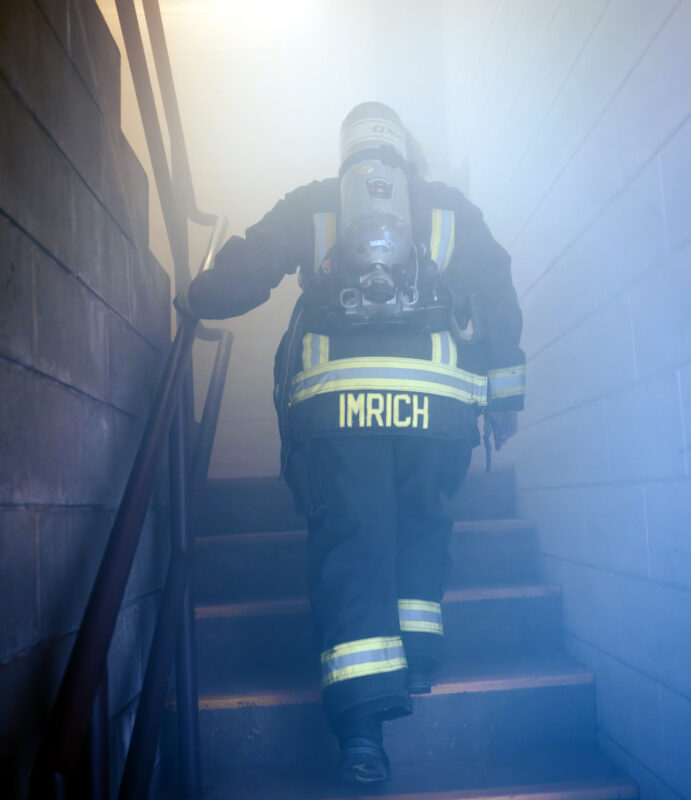
The decision came after the city’s CEO and a Vernon councillor participated in an IAFF FIRE OPS 101 held by the BCPFFA in Revelstoke in early May, which included a stairwell scenario complete with theatre smoke.
Vernon Local 1517 President Rob Cucheran said the IAFF FIRE OPS 101 event made the difference.
“With Local 1517 members in front of them, and behind them, we were able to demonstrate the realistic dangers and challenges that single-egress buildings pose to occupants and fire fighters,” he said. “We were able to solidify their view that our current staffing in Vernon is not adequate in many areas, especially to effectively and safely conduct operations at a single-egress building fire.”
In a social media post thanking city council, Local 1517 quoted a councillor who took par tin the exercise:
“When we climbed through that stairwell filled with smoke, and you had people coming down and fire fighters going up, it was chaos. It’s the fire fighters that are simply saying, ‘Look, it may be safe from a planning perspective, but the reality is there’s a decision between evacuating people and putting out the fire.”
A unanimous vote in West Kelowna
In May, advocacy from West Kelowna Local 4457 and Fire Chief Jason Broland led to the unanimous adoption of a policy requiring two stairwells in any new residential buildings in the city pending further review. Broland told the council the department’s rescue capabilities don’t align with its operational capacity or with the intensified prevention and inspection programs required to safely manage single-exit buildings.
“This is a significant design change that stands to impact both public and fire fighter safety, and I’m pleased that Mayor Gord Milsom and City of West Kelowna Council listened to those concerns and decided to hit the pause button on this,” West Kelowna Local 4457 President Nathan Pike said.
6th District Vice President Mike Carter commended the BCPFFA and its locals for pushing back on single-exit residential building designs. “The IAFF stands with our affiliates in their advocacy and fights against this dangerous practice which puts profits ahead of fire fighter and public safety.”
What comes next
The IAFF and the Metro Chiefs Association have released a joint statement outlining the dangers single-exit stairwell residential buildings pose and stating clear opposition to lowering safety requirements in building codes and standards. The Canadian Association of Fire Chiefs has also expressed concerns.
The National Research Council of Canada is conducting research initiatives and stakeholder consultation on allowing single-exit stairways in midrise residential buildings under the National Building Code. Vancouver Local 18 member James Johnson, the IAFF’s Codes and Standards representative in Canada, sits on an NRC task group studying the issue.
In the meantime, the BCPFFA and its affiliates are working to make sure municipal candidates understand the risks – and that voters do too.