The following is General President Edward Kelly’s column from the Spring 2026 edition of Fire Fighter International Magazine.
Across the United States and Canada, the story is the same. IAFF members are responding to emergency calls with fewer personnel than recommended by NFPA standards.
This puts fire fighters and emergency medical workers in an impossible position. Two people can’t do a proper size-up, throw ground ladders, force entry, catch a hydrant, stretch lines, make an initial attack, ventilate, and search for occupants all at once. It takes a full crew to do the job effectively. When there aren’t enough fire fighters on scene, critical tasks don’t get done when they need to. Lives – both the public and our own – depend on having enough properly trained and properly equipped fire fighters on scene to act immediately.
Without proper staffing, there are always consequences.
We saw it last summer in Fall River, Massachusetts, when a fire tore through an assisted living facility, killing 10 residents and injuring five fire fighters. Eight of the fire department’s 10 companies were running with three fire fighters – below NFPA response standards. Within minutes, crews encountered heavy fire and dozens of residents who couldn’t self-evacuate. As the situation worsened, command called for more resources – “send me everybody.” Off-duty members responded from home. Neighbors grabbed ladders from nearby vans to assist fire fighters with rescues.
There’s no doubt that more people would be alive today had the Fall River Fire Department been properly staffed with eight more fire fighters on scene that night. Within hours of the fatal fire, the IAFF was there, supporting our members and making the case for staffing to national standards. To his credit, two days later, the mayor agreed to add a fourth fire fighter to four more companies.
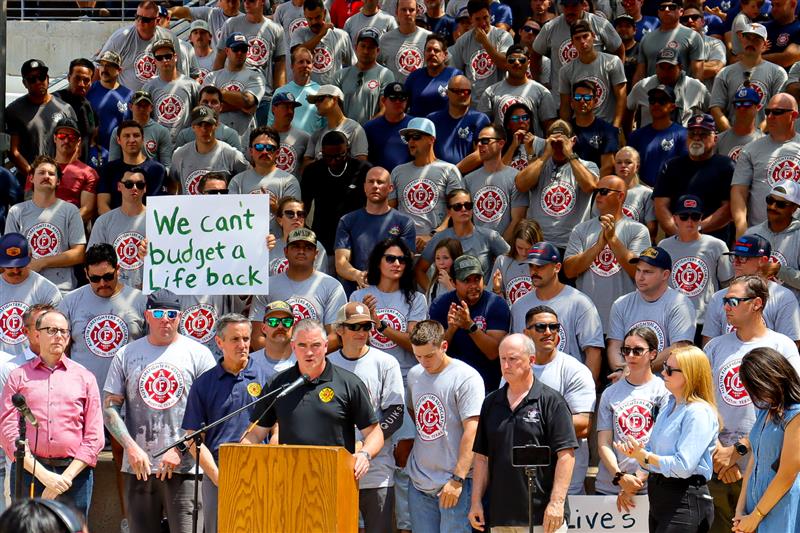
Just a week before, we were in Charlottetown, Prince Edward Island, for the Atlantic Provinces Professional Firefighters Association’s “4 Fire Fighters 4 Your Safety” rally, where John Bell, of Charlottetown Local 5219, recounted a mayday that nearly turned deadly.
He and another member were conducting a rescue on the upper floors of a building when they became trapped. The third fire fighter – who was single-handedly throwing ground ladders to occupants hanging out the window – didn’t hear their mayday call. Whether it was luck or divine intervention, no one died that night. “All of that would have simply been avoided if we had another guy,” Bell said.
Different communities, different countries. But the same problem. Without proper staffing, lives are at risk.
That’s where the work of the IAFF’s Technical Assistance and Information Resources (TAIR) Division comes in.
TAIR gives Locals the information they need to make the case for better staffing and resources. They analyze dozens of data points – from call volume and response times to station locations, area hazards, and population demographics – to create detailed reports showing exactly what it takes to get enough fire fighters on scene, in time, to meet national standards.
The Division is staffed by 26 professionals who do this work every day. In FY2025 alone, they completed 781 projects for our 3,609 Locals – supporting one in five IAFF affiliates in the U.S. and Canada. You can read more about how TAIR is shaping our fight for safer staffing on Page 22.
That’s the work of this union – protecting our members and those we serve.
And this year, we secured one of the most significant legislative achievements in our history with the passage of the Honoring Our Fallen Heroes Act.
Cancer has ravaged our ranks for too long, and for 50 years, families of fire fighters who died from occupational cancer were denied federal benefits under the Public Safety Officers’ Benefits (PSOB) program. The Honoring Our Fallen Heroes Act adds 20 cancers to the PSOB program and establishes a presumption that those cancers are job-related. It also ensures families receive the $461,000 in federal death benefits they are entitled to.
Before it was signed into law by President Trump, we were told the bill had no shot of passing. It was too expensive. The votes weren’t there. But the IAFF – led by the family of our fallen brother Mike Paidar, from St. Paul, MN Local 21 – lobbied Congress. From Capitol Hill to the Oval Office, we used every relationship and every meeting as an opportunity to see this through. It’s what we owe our fallen and their families.
Make no mistake. That’s what this union does every day. In ways big and small, the IAFF is delivering on our mission – to protect you, your family, and your community.