When service ends for a member of the U.S. military, the desire to protect and serve rarely does.
For many veterans, a career in the fire or emergency medical services offer a familiar sense of duty and purpose – teamwork, discipline, and operating in high-stakes environments.
“I, and thousands like me, joined the fire department after being in the military because serving my country and my community is all I ever wanted to do,” said General President Edward Kelly, who served in the U.S. Air Force before joining the Boston Fire Department. “Across North America, that path from military service to the firehouse is clearer than ever. Through apprenticeship programs, veterans’ preference policies, and Department of Defense initiatives, the IAFF and its partners are helping veterans turn their experience into a new career that keeps them in service.”
Here’s a closer look at how the IAFF is connecting with veterans this Veterans Day – and helping them transition to new roles serving their communities.
Apprenticeships
Fire fighter apprenticeship programs offer training that is often eligible for GI Bill benefits, a monthly education stipend.
The IAFF, in partnership with the International Association of Fire Chiefs, created the first federally registered apprenticeship program for the fire service. The program was established with the U.S. Department of Labor to help address recruitment and retention issues facing many departments.
The program will soon be available through fire departments and community colleges nationwide.
“Together with the fire chiefs, we’ve launched this federal apprenticeship program to boost the ranks of the American fire service with experienced men and women ready to answer the call and improve recruitment and retention in their communities,” Kelly said.
The IAFF is also working with the Veterans Administration to establish the apprenticeship as an education center eligible for GI benefits. The program will be available through the Department of Defense’s SkillBridge program.
The largest statewide fire fighter apprenticeship program is the Cal-JAC training program.
The California Firefighter Joint Apprenticeship Committee is a labor-management collaboration between the California Professional Firefighters and the Office of the State Fire Marshal . It can be accessed by anyone looking to become a fire fighter in California.
Yvonne de la Pena is the Executive Director of Cal-JAC.
“Our recruiters are always looking for top tier candidates for this program. Our veterans are the best,” de La Pena said. “We have more than 400 active-duty military personnel who have passed the Candidate Physical Ability Test (CPAT) and written tests, ready to begin the program. And we have 35 fire departments that have apprentices using their GI benefits.”
Apprenticeship training consists of an academy, followed by instruction that supplements academy work and true-to-life work experience through on-the-job training.


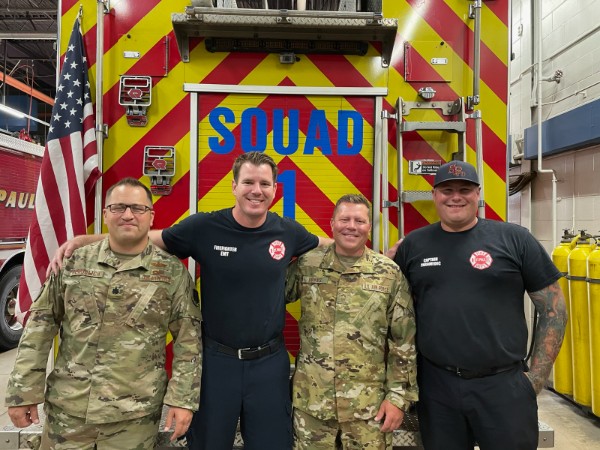
In St. Paul, Minnesota, Local 21 and the city’s fire department developed the Saint Paul Fire Department Joint Apprenticeship Training Program, which has been approved by the Minnesota Department of Labor and Industry’s Division of Voluntary Apprenticeship and the Veterans Administration for GI Bill benefits.
Each newly hired fire fighter, including veterans, automatically enters the apprenticeship program. They maintain apprentice-level status for the first three years of employment, or until completing all required coursework, testing, and practical skill evaluations.
“The structure and support built into the program, its progressive evaluation, mentorship, and clear standards, make it especially compatible for those transitioning from the military, whose background in discipline, teamwork, and structured progression aligns naturally with the program,” Local 21 President Kyle Thornberg said. “Successful completion of the program leads to certification as a journey-level fire fighter.”
The photos below were provided by Local 21.


Department of Defense SkillBridge program
The Department of Defense SkillBridge program allows service members to gain valuable civilian work experience, including fire and emergency medical service, through specific industry training, apprenticeships, or internships during the last 180 days of service.
Providers, like the Hero-to-Hero program and soon, the IAFF Fire and EMS Apprenticeship Program, are affiliated with SkillBridge.
North Whidbey Island Fire and Rescue (Washington) – with the support of Whidbey Island Local 4299 – has been a SkillBridge provider for several years. It’s an opportunity hundreds at the island’s naval air station have utilized.
The program’s participants get hands-on experience in daily fire station operations, crew communication, ambulance transport, emergency response, civil service testing, and interview preparation. And they can earn their fire fighter or emergency medical certifications.
“They come to us with an understanding of command structure and experience working in a high-risk environment. And they are fast learners,” Local 4299 President Justin Burnett said. “We are a combination department and consider those who go through our program an essential piece of our staffing structure.”
The Houston Fire Department just became a SkillBridge provider this year.
“It has long been policy to encourage veterans to join our department by giving them five extra points on the entry exam, but we wanted to do more, and that’s why we decided to connect with the DoD program,” said Houston, TX Local 341 member Mohammad Koochack. He’s the assistant chief in charge of developing and managing the program.
The fire department currently has more than 400 veterans. That number is expected to rise as the department actively recruits for this program on nearby military bases. Once accepted into the program, veterans or those looking to exit the military will go through the department’s training academy.
Fire departments with veterans’ preference policies
Most fire departments have veterans’ preference policies and incentives to encourage them to become fire fighters or emergency medical service personnel once they leave the service.
For example, the Fire Department of New York actively recruits veterans. There are currently more than 1,400 veterans or military reservists in the FDNY.
One way the department recruits is through the Army PaYS program. The program is designed to help soldiers prepare for a new career after serving in the army.
The FDNY guarantees soldiers a job interview with the Office of Recruitment and Retention, as well as possible employment.
The Pittsburgh, Pennsylvania, fire department has a veterans’ preference policy for those who pass the fire department’s written test and the CPAT. Ten extra points are added to their overall score.
“They come to us already knowing what it truly means to serve the community and helping people on what is probably the worst day of their lives,” Pittsburgh Local 1 President Ralph Sicuro said. “The veterans’ preference policy has brought in many of our best fire fighters.”
Military service men and women looking to leave the military to become a civilian fire fighter or emergency medical service professional are encouraged to explore assistance options at the federal, state, and local levels. A good place to start is the Department of Defense’s Transition Assistance Program and the recruitment office at the fire department where they hope to work.