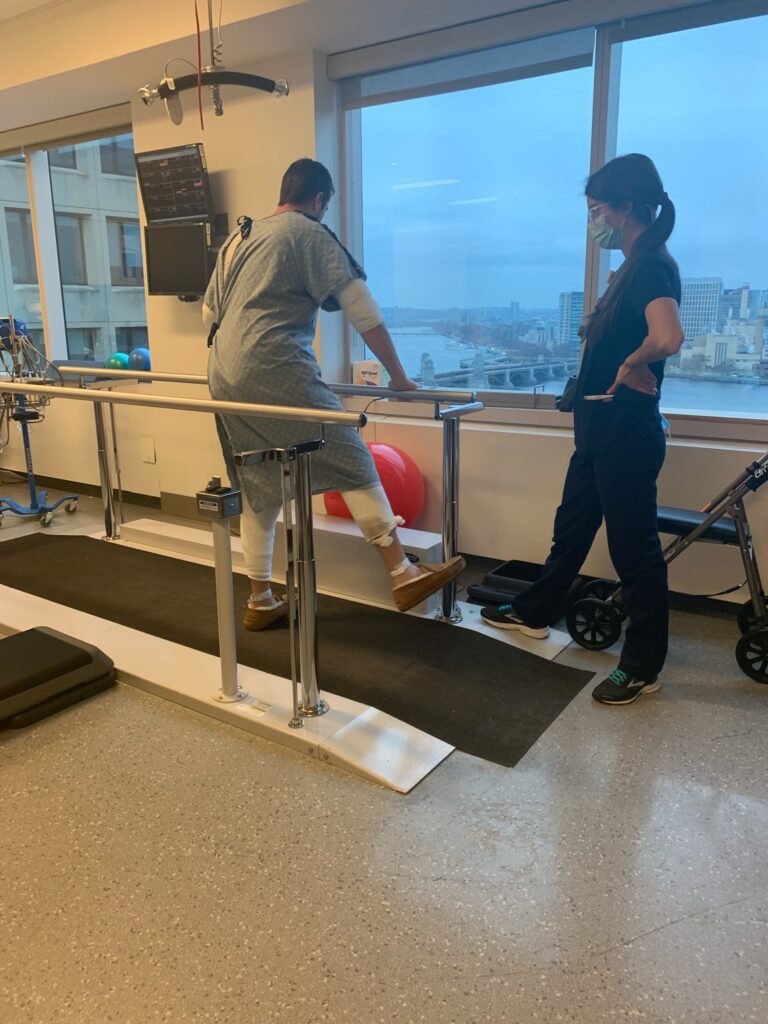
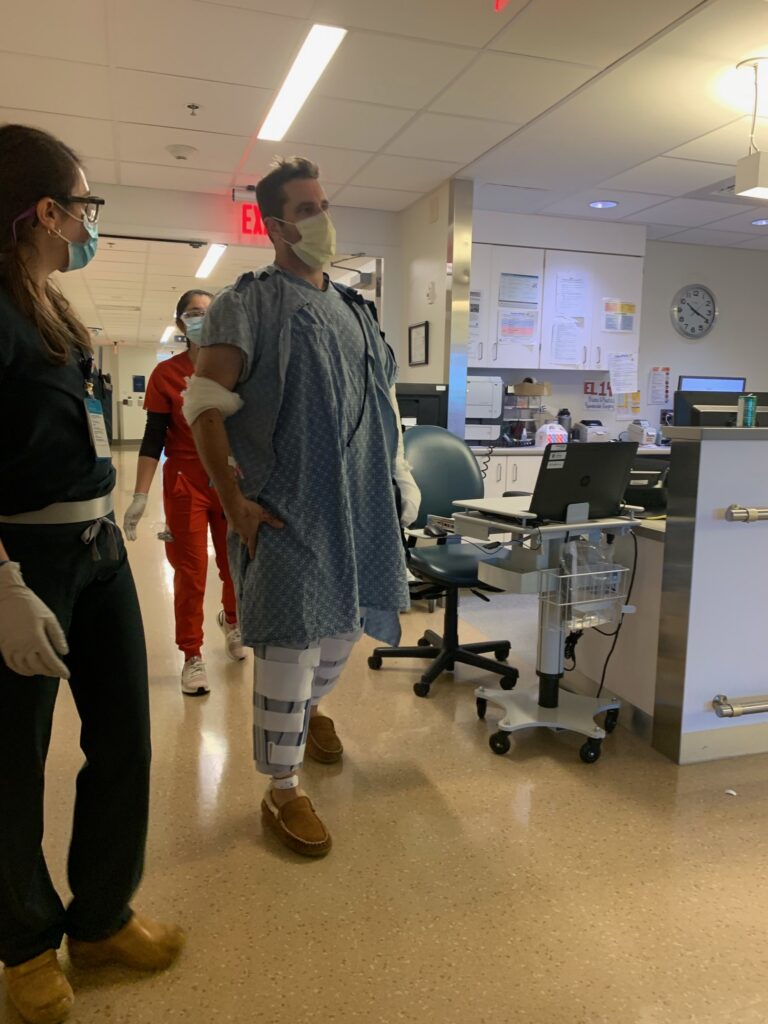
Steve DesRuisseaux, a member of Manchester, NH Local 3820, rushed inside a burning six-unit building alongside his nozzleman to search for trapped victims .
Visibility was near zero when he found survivors who could not find their way out.
“The fire was intense and conditions were changing rapidly, so I grabbed one of the residents who couldn’t get out, made my way to a window, and called for a ladder,” he said. “But before we could get out, there was a flashover.”
DesRuisseaux could feel himself burning as he made his way outside and onto the ladder. But then, a piece of his gear got caught on the ladder, flipping him upside down. That’s when another fire fighter climbed up the ladder and freed him.
He fell to the ground and crawled to his crew, who put out the flames. He was in the fire for 35 to 40 seconds – long enough to suffer second- and third-degree burns over more than a third of his body.
Crews rushed him to the nearest ER, but his injuries required care at a regional burn center. Within hours, he was on a medevac flight to Boston, where his care was already being coordinated through the IAFF Burn Injury Assistance program.
Managed through the IAFF Foundation, the program supports fire fighters and their families across the U.S. and Canada with financial assistance, peer support, burn prevention education, and advocacy.
“In this union, there’s no battle that a member takes on alone,” General President Edward Kelly said. “When one of our own suffers a serious burn, the IAFF’s Burn Injury Assistance program helps them get the specialized care they need to recover.”
Ensuring treatment at a burn center
There are about 130 burn treatment centers in the United States and about 20 in Canada, so not every municipality has one nearby . The IAFF makes sure injured members are transferred to specialized centers to receive the immediate care they need.
“It is important that all burns, even ones that look small, should be treated by a specialist,” IAFF Burn Coordinator Phillip Tammaro said. “This is because a burn is a complex wound that can continue to spread if not treated properly. It can also penetrate multiple layers of skin which will complicate and prolong the healing process and may even impact your respiratory tract.”
The conditions fire fighters work in can lead to complex burn injuries rarely seen outside the profession. Steam burns occur when water gets trapped between the PPE and the skin. Compression burns happen when superheated gear presses against the body.Inhalation burns result when a mask fails or isn’t fully sealed.
Burn centers are uniquely equipped to handle these complex injuries, with multidisciplinary teams that work together through every stage of recovery . These centers can also perform advanced surgical procedures such as escharotomies – cutting into burned skin to prevent restricted circulation – and are staffed with experts in wound infection control.
Building a recovery network
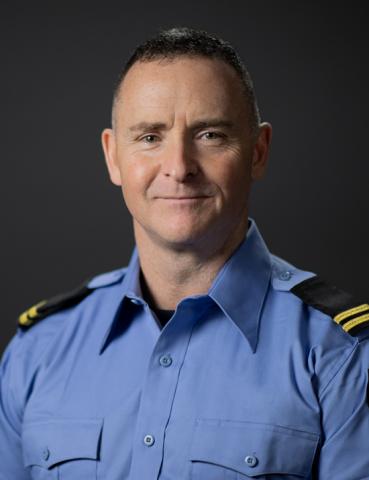
Lionel Crowther, 13th District Burn Coordinator and member of Winnipeg, MB Local 867, knows firsthand how difficult the recovery process can be.
He responded to a fire in February 2007 when he and two other fire fighters were caught in a flashover. He was the only survivor and suffered burns to 70% of his body.
Two years later, Crowther was appointed as a burn coordinator.
“The most beneficial work that we do is getting the resources ready –to go ahead of time,” Crowther said. “We make sure Local presidents know how to contact their district burn coordinator and burn coordinators should be maintaining contacts with burn centers, hotels for families to stay, and peer support contacts.”
Having a plan in place ensures burn survivors get what they need quickly – and reduces stress when someone is there to guide them through the process .
Peer support, he said, is also a critical part of the process.
“I try to match burn survivors who have experienced similar injuries,” Crowther said. “This gives survivors someone to talk to who truly understands. And it also lets them see that recovery and getting back to a life they recognize is possible.”
Supporting the whole family
Burns don’t just affect the survivor – they impact the whole family.
The daughter of a Goodyear, AZ, Local 4005 member was seriously injured in a multi-vehicle crash.Trapped inside her car after it was engulfed in flames, she suffered severe burns before being rescued by a nearby police officer.
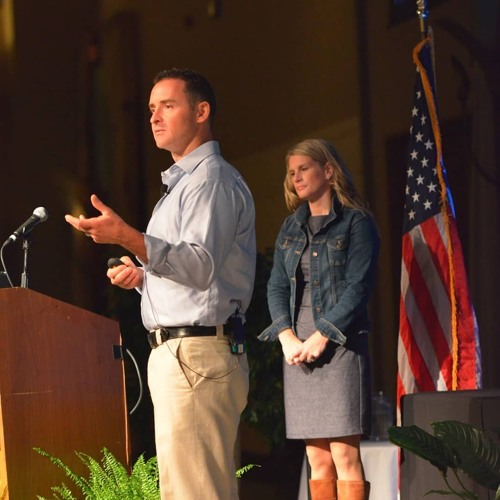
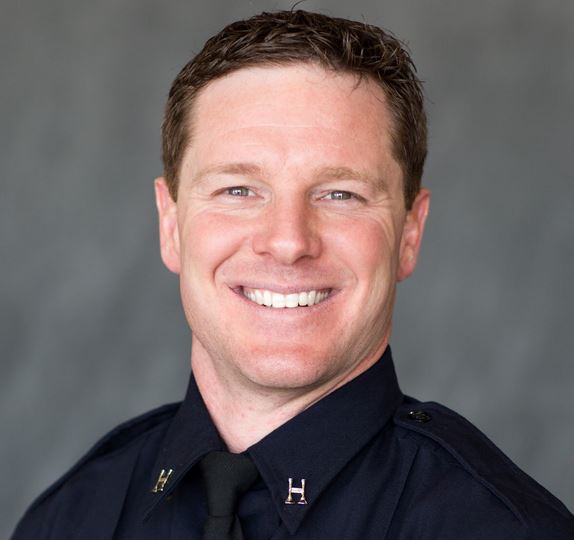
“A big part of what the Burn Injury Assistance program does is help families,” said Hunter Clare, 10th District Burn Coordinator and Phoenix, AZ, Local 493 member. “For this daughter of a Local 4005 member, we worked with the Local to provide financial support and helped ensure all recovery needs were being met.”
Clare is another IAFF member who knows first-hand what recovery looks like. In 2019, he suffered severe chemical burns in a massive lithium-ion battery energy storage system (BESS) explosion while responding to reports of smoke at a battery storage facility. His recovery required multiple surgeries and other medical interventions.
“It was a lot on my family. We really needed that support,” he said.
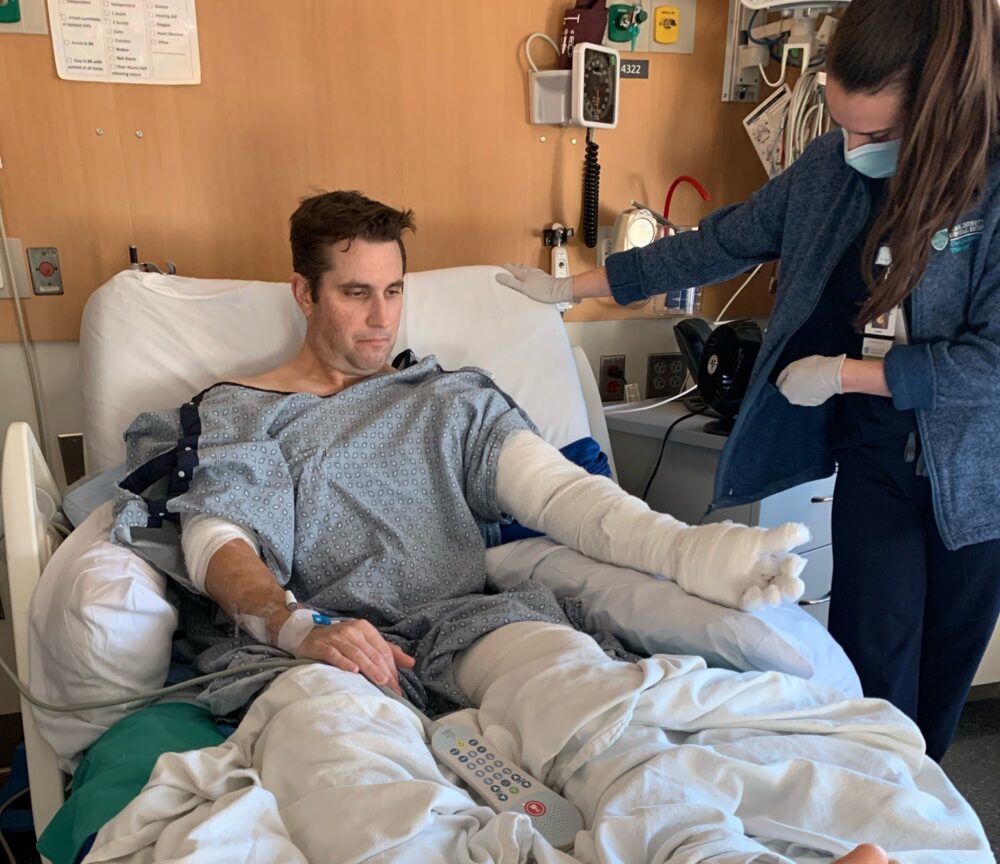
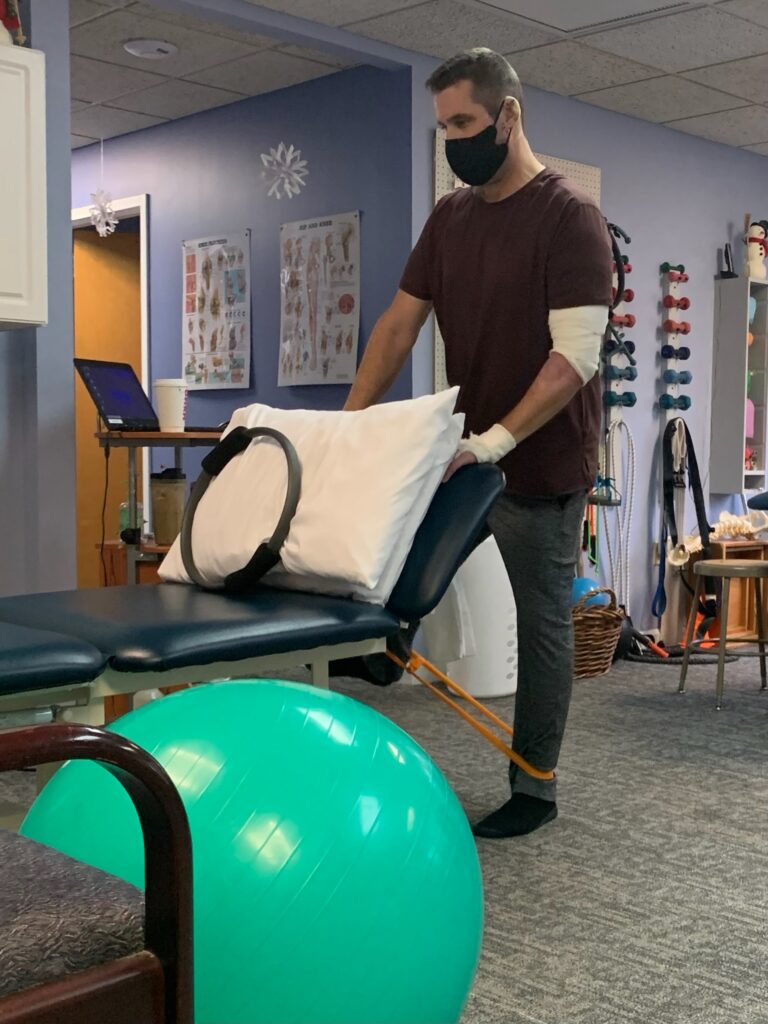
For DesRuisseaux, recovery meant six surgeries, including skin grafting, and a month-long stay at the burn center.
“I was in a different state, so the family support that the IAFF Burn Injury Assistance program and Boston Local 718 gave was invaluable,” he said. “They were even able to coordinate training for my wife to help with the dressing on my burns as they healed.”
DesRuisseaux returned to the job seven months later. The key, he said, was accepting help.
“There is nothing about it that is easy. It takes a long time. It takes support. And you need to be willing and able to take that support,” he said. “Let them help you. Don’t pretend to be fine when you’re not fine. Accept the help.”
Visit iaff.org/burn-injury-assistance for more information.