After years of IAFF Manitoba advocacy, lawmakers introduced a bill Nov. 26 that would extend presumptive coverage to all primary cancers and Parkinson’s disease. It would also make Manitoba the first jurisdiction in North America to presume ALS is occupational in fire fighters.
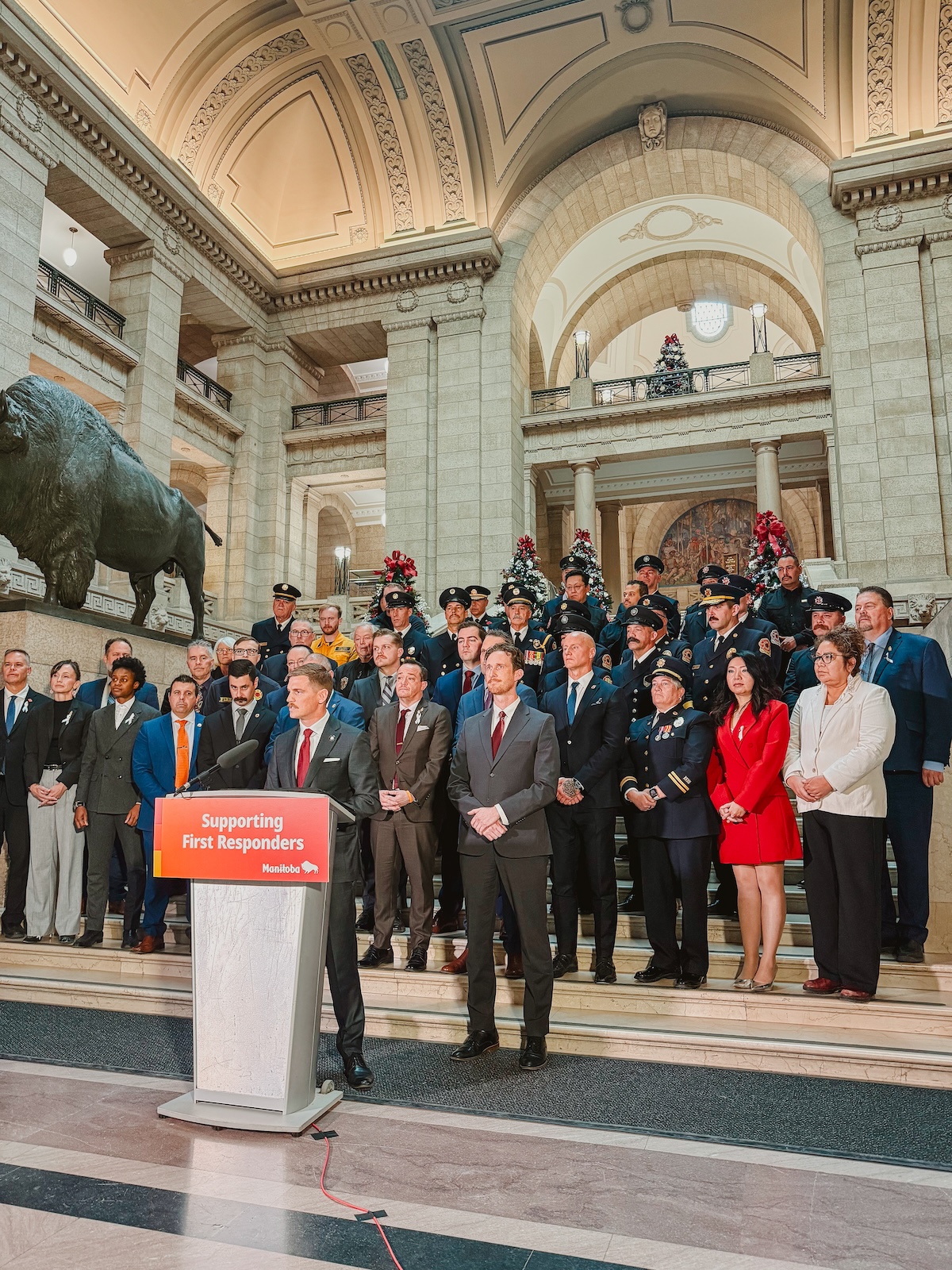
Dozens of IAFF members and other fire service stakeholders watched from the public gallery as Bill 7 was introduced. The bill would also reduce the minimum service requirement for cancer coverage to two years, waive latency periods after catastrophic exposures and eliminate the 24-hour restriction on cardiac injury coverage.
The legislation, introduced and backed by the province’s majority New Democratic Party (NDP) government, would apply to qualifying diagnoses dating back to January 1, 2016.
“IAFF Manitoba spent years pressing for stronger protections for fire fighters who develop occupational disease,” General President Edward Kelly said. “Bill 7 reflects that, and is a significant step forward for our members in Manitoba and their families.”
It is hoped that the legislation will advance quickly through the legislative process and be enacted in the spring.
In marking the bill’s introduction, IAFF Manitoba President Nick Kasper said it will give the province “the most comprehensive firefighter presumptive legislation anywhere in the world, establishing a new benchmark for the protection of fire fighters and their families.”
Kasper expressed his gratitude to Manitoba Premier Wab Kinew, Labour Minister Malaya Marcelino and to David Pankratz, a fire fighter and Winnipeg, MB Local 867 member who was elected to the Manitoba Legislature in 2023. He was recently appointed Minister Responsible for First Responder Initiatives, an innovative role dedicated to supporting the province’s fire fighters, paramedics and police.
He also thanked Kelly for making IAFF resources available through the Medical Assistance Program (MAP).
“Today, Manitoba is showing the world what it means to stand behind its firefighters,” Kasper said, adding that fire fighters diagnosed with occupational illness should be fighting for more time with their families, not fighting for recognition that their profession made them sick.
“This historic legislation honours the sacrifices of generations of firefighters and provides greater peace of mind to those who continue to serve and their families.”
Kasper, who is also President of Local 867, noted that it took the province 25 years to move from five cancers to 19 cancers, and now it would move past the cancer-by-cancer approach altogether.
“We cannot give back the years that occupational disease has taken from our fire fighters and their families. But today, we have honoured their sacrifices by strengthening protections for next generation and ensuring that those who dedicate their lives to protecting others are never left to fight alone,” he said.
Assistance from the IAFF
The IAFF worked closely with IAFF Manitoba on its approach to expanding presumptive legislation in the province.
Dr. Dan Whu, who leads the IAFF’s MAP program, and Ottawa Local 162 member Neil McMillan held a two-hour meeting with Manitoba officials June 24 in Winnipeg to advocate for enhanced occupational disease coverage for the province’s 1,600 IAFF members, who protect Manitobans across five IAFF locals.
During the meeting, the IAFF laid out strong evidence in support of significantly expanding Manitoba’s presumptive coverage for fire fighter occupational diseases.
IAFF member in provincial cabinet played key role
In a social media post, Pankratz, who began his firefighting career in 2013 and represents the Winnipeg-area riding of Waverly, thanked Premier Kinew, Minister Marcelino, General President Kelly, Kasper and the IAFF’s Dr. Whu and Neil McMillan “and many, many others who led this work and advocacy” for many years.
“I used to ride the truck with people this bill could help. Having a hand in it means a great deal to me,” said Pankratz, who introduced Bill 7 in the Legislature.
Present at the Manitoba Legislature in Winnipeg Thursday for Bill 7’s introduction were members from every IAFF affiliate in the province, including the entire IAFF Manitoba Executive Board, as well as representatives from the Manitoba Association of Fire Chiefs and the Manitoba Association of Native Fire Fighters, wildland fire fighters and paid-on-call fire fighters.
Political action made a difference
Through successive governments, IAFF Manitoba has conducted focused political action initiatives and maintained strong relationships with provincial legislators, winning improvements to its presumptive regime numerous times since Manitoba became the first jurisdiction in Canada to enact presumptive legislation for fire fighter occupational diseases in 2002.
Kasper said the political action by affiliates across the province was a key factor in events leading up to the introduction of Bill 7.
“The fact the political action work was done made all the difference, full stop,” Kasper said.
North America’s first presumption for ALS
With growing evidence that the toxic exposures fire fighters face as a result of their duties may contribute to neurodegenerative diseases such as ALS and Parkinson’s, the introduction of Bill 7 proposing North America’s first presumptive coverage for those diseases cout set a precedent across the continent.
Research cited in an IAFF position paper indicates that fire fighters face approximately twice the risk of dying from ALS compared to the general population. Occupational exposures to polycyclic aromatic hydrocarbons (PAHs), pesticides, heavy metals and other toxins are among the potential contributing factors being investigated.
In the U.S., the IAFF is further studying the potential link in partnership with the Muscular Dystrophy Association (MDA).
At the IAFF 58th Convention in Arlington, Texas, in August, delegates adopted Resolution 54, which commits the IAFF to advancing research into occupational neurodegenerative disorders, including ALS, Parkinson’s disease, Alzheimer’s disease and other conditions potentially linked to fire service exposures.
In October, IAFF Alberta lobbied the Alberta government to introduce presumptive coverage for neurodegenerative diseases. Among those who participated in the advocacy was Chestermere, AB Local 5284 President Kimball Yorston, whom the IAFF is rallying around as he wages his own battle with ALS.
The birthplace of presumptive legislation in Canada
With the enactment of Bill 5 in 2002, which deemed five types of cancer as occupational, Manitoba was the first jurisdiction in Canada to introduce presumptive legislation for fire fighters.
As the result of persistent advocacy by IAFF affiliates, other provinces followed suit, building on previous advances to cover more cancers and to introduce coverage for heart injury and post-traumatic stress injury.
Today, thanks to affiliate advocacy, a robust framework of presumptive coverage for occupational diseases linked to firefighting exists in all 13 provinces and territories and across most U.S. states.
Manitoba currently covers 19 cancers as well as heart injury and post-traumatic stress injury.