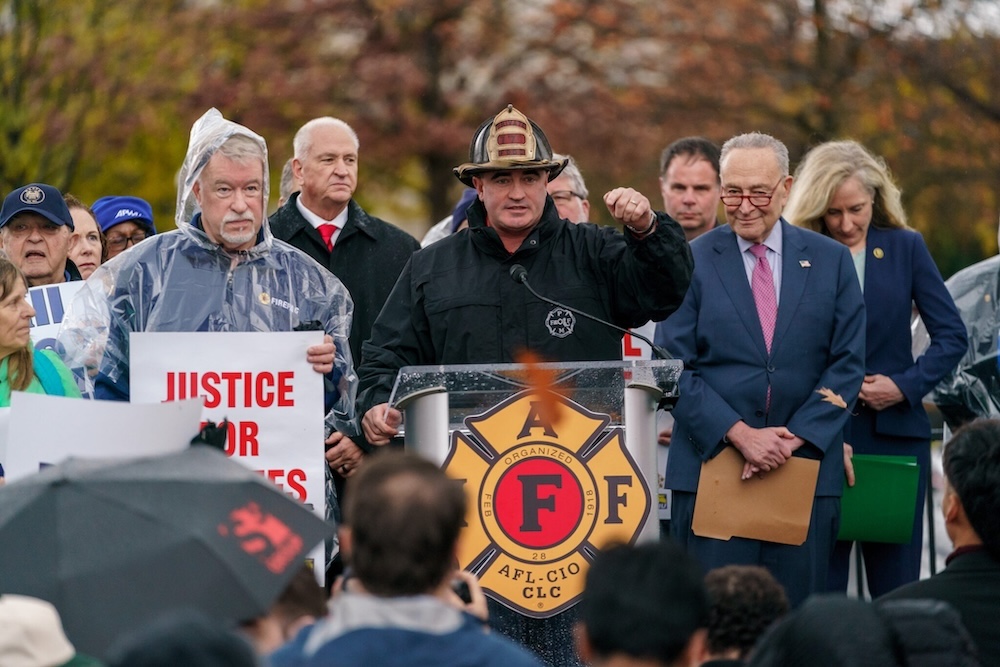
“We promise you the IAFF will go wherever the fight is.”
That’s the message that echoed through New Orleans during the IAFF’s Affiliate Leadership Training Summit in January, as General President Edward Kelly laid out the union’s vision for the year ahead. It’s a motto that guided the IAFF this year, and one that was upheld – as the union achieved major victories to strengthen fire fighters’ retirements, collective bargaining rights, health and safety, and other key issues impacting members and their families.
Through relentless advocacy, bipartisan coalition-building, and coordinated efforts across the United States and Canada, the IAFF’s key priorities turned into tangible results – results that will have a major impact in the daily lives of North America’s fire fighters.
Honoring Our Fallen Heroes Act
In the union’s biggest legislative initiative of the year, the IAFF secured passage of the Honoring Our Fallen Heroes Act. The bill, which was led by Sens. Amy Klobuchar (D-Minn.) and Kevin Cramer (R-N.D.) and Reps. Carlos Gimenez (R-Fla.) and Mary Gay Scanlon (D-Pa.), amends the federal Public Safety Officers’ Benefits (PSOB) program to include occupational cancer as a line-of-duty death –extending up to $461,000 in death and educational benefits to the survivors of fire fighters who die from job-related cancers.
“This was truly a bipartisan effort,” said General President Edward Kelly, who also thanked President Donald Trump, whose support was crucial in passing one of the most impactful pieces of legislation in IAFF history.
The IAFF led the fight to pass the Honor Act by:
- Holding multiple lobbying days with IAFF members and survivors on Capitol Hill.
- Prioritizing the legislation at the 2025 Alfred K. Whitehead Legislative Conference in Washington D.C.
- Amplifying the voices and stories of survivors of fallen fire fighters through the IAFF’s Honor Act testimonials.

Retirement Security
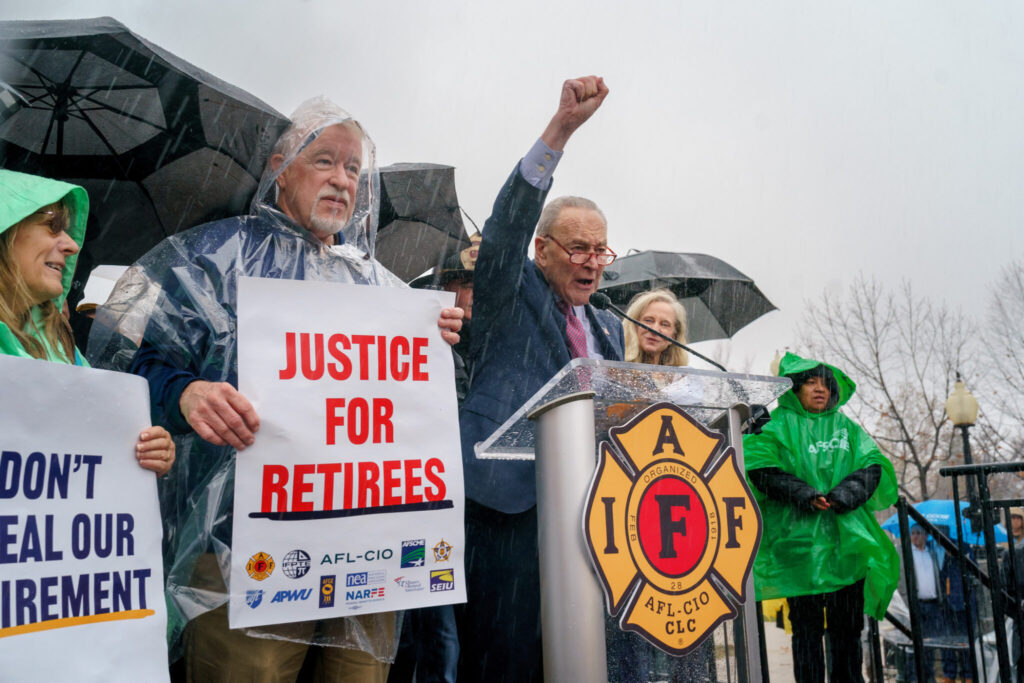
After more than 40 years of injustice, the Social Security Fairness Act was signed into law in January of this year, thanks to the IAFF’s strong advocacy. The union led the successful bipartisan effort to eliminate the Windfall Elimination Provision (WEP) and Government Pension Offset (GPO), ending decades of unfair penalties and restoring full Social Security benefits to fire fighters, police officers, teachers, and other workers who paid into the system.
Kelly praised the work of the IAFF and other labor unions who played a significant role in pushing Congress to act. “Nobody in Washington thought we could get this done – but we never let up, and thanks to allies like Fraternal Order of Police President Pat Yoes and American Federation of Teachers President Randi Weingarten, we were able to make history for America’s retired public employees.”
Here’s how the IAFF led with action:
- Made repeal of the WEP/GPO a top priority when General President Edward Kelly took office.
- Organized repeated rallies and direct lobbying efforts on Capitol Hill.
- Built a broad coalition with police, teachers, and other public employee unions.
- Mobilized members to send more than 30,000 messages to Congress through the IAFF Advocacy Center demanding passing of the legislation.
- Helped push forward a historic discharge petition, sending the bill to the House floor for an up-or-down vote.
Safe Staffing
Staffing decisions can be the difference between life and death.
This year, the IAFF doubled down on securing safe staffing and equipping affiliates with the tools they need to fight back. The union launched its new “Securing Minimum Staffing” toolkit, giving Locals research, data, and organizing strategies to meet the NFPA 1710 staffing standard.
The issue came to the forefront following a deadly fire in Fall River, Massachusetts, and budget-driven staff cuts in Canada. “Across North America, too many departments are jeopardizing public safety by sending understaffed crews to respond to structure fires,” said Kelly. “Fire fighters will always answer the call, but we can’t properly protect our communities unless we have the staffing to respond safely and effectively.”
Here’s how the IAFF stood by Locals as they fought for minimum staffing:
- Launched the “4 Fire Fighters 4 Your Safety” public safety campaign with the Atlantic Provinces Professional Fire Fighters Association.
- Responded immediately to support Fall River, MA Local 1314 after a deadly assisted-living fire exposed dangerous understaffing. Advocacy by Kelly, 3rd District Vice President Jay Colbert, and Massachusetts state and Local leaders, led to increased staffing just two days later.
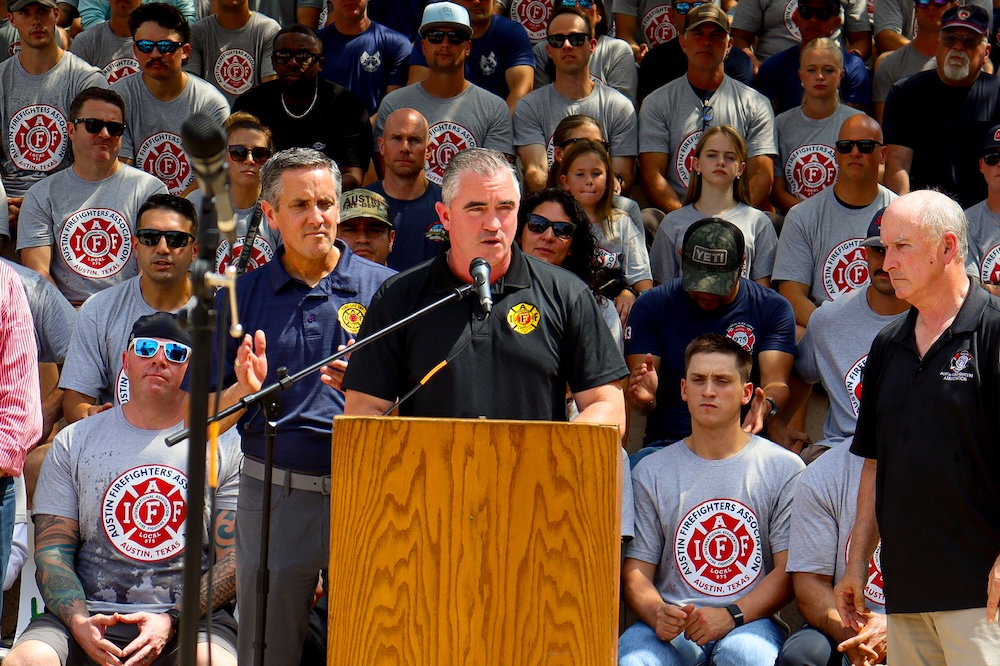
- Opposed proposed staffing rollbacks in Austin, TX, where Local 975 held a powerful rally with hundreds of members, Kelly, and 11th District Vice President Michael Glynn in support of a Local-led petition to protect four-person engine companies.
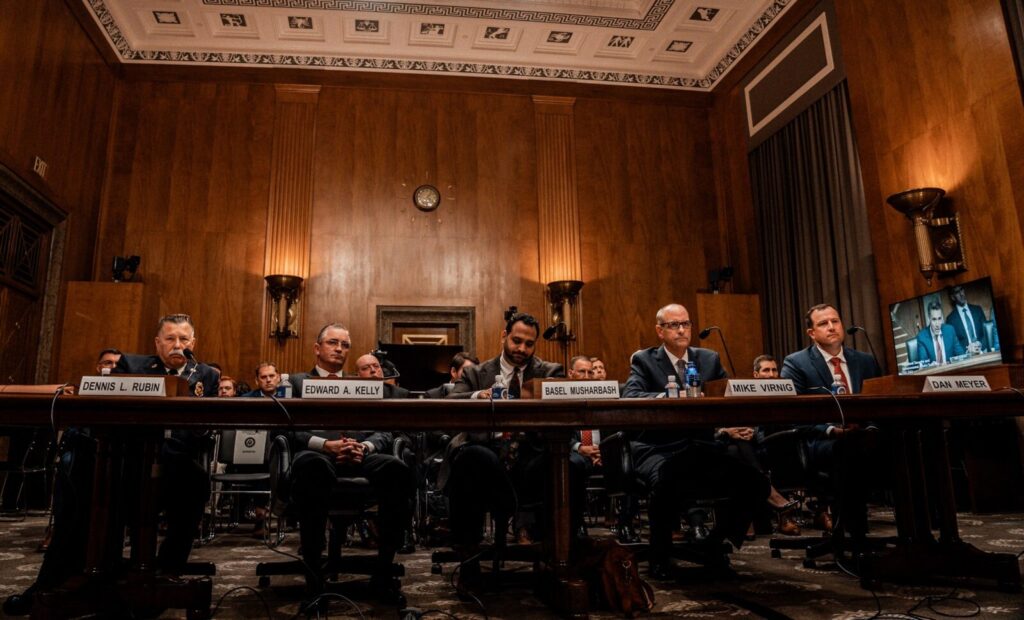
Security Subcommittee hearing on Capitol Hill.
Apparatus Accountability
Fire fighters across North America continue to feel the impact of soaring apparatus prices and years-long delivery delays. But the IAFF is fighting back.
Earlier this year, the IAFF sent a joint letter, along with the American Economic Liberties Project, calling for a federal antitrust investigation into the apparatus industry. Additionally, with the IAFF’s support, Senators Jim Banks (R-IN) and Elizabeth Warren (D-MA) opened a bipartisan investigation into private equity’s role in fire truck manufacturing.
In September, Senators Josh Hawley (R-MO) and Andy Kim (D-NJ) held a hearing on the critical delays, inviting Kelly to provide expert testimony on the issue before a U.S. Senate Homeland Security Subcommittee. Sitting next to executives from REV Group and Pierce Manufacturing – two of the largest fire apparatus manufactures – Kelly highlighted stories from Locals dealing with unsafe, aging equipment and how the delays in upgrading failing engines and trucks are threatening public safety.
“The data compiled by the IAFF and others leads one to conclude that these market conditions were planned and executed by corporate interests that do not share our collective goal of public safety,” Kelly told the committee.
Hawley had sharp words for the manufacturers during the hearing, dismissing their claims that the delays and price increases were due to market conditions.
“It’s a deliberate company strategy, isn’t it? Your CEO is boasting about it on earnings calls,” said Hawley.
In Canada, the IAFF expressed concerns about apparatus issues, highlighting that fire departments wait years and incur high costs for new trucks. With engines now costing over $1 million and ladder trucks up to $2 million – and taking years to be delivered – the union will continue working with elected officials in both the U.S. and Canada to ensure the shortages are addressed and manufactures are held accountable.
Advancing Health and Safety
Health and safety remain a top priority, with the IAFF continuing its fight to reduce cancer in the fire service. This year, the union continued to push for reforming and updating OSHA’s Emergency Response Standards, influenced changes to NFPA standards, and raised awareness about PFAS chemicals found in turnout gear. In Canada, IAFF advocacy helped to include PFAS as a complete class of chemicals under Canada’s environmental laws and further limit their use in firefighting foams.
And the Medical Assistance Program, formally adopted by delegates at the 57th Convention, stood by members and their families wrongly denied benefits they were rightly owed. After years of legal battles, Memphis, TN Local 1784 Fire Fighter/EMT Jeffrey Scott Arick’s family won full line-of-duty death benefits with the IAFF’s support. Arick died of a heart attack after a 30-hour shift in 2020. “The union was my lifeline, and they didn’t just fight for the benefits. They checked on us, prayed for us, became friends, and that meant everything,” said Stephanie Arick, Jeff’s wife.
Bottom Line
These wins didn’t happen by accident. They happened because fire fighters and emergency medical workers organized, stood together, and demanded better. The IAFF made sure those voices were heard in the halls of power. From retirement security to long-term health and safety, the union delivered real results that matter.
“2025 was one of the IAFF’s most successful years in our 107-year history,” General President Edward Kelly said. “From major legislative victories to securing critical changes to protect the health and safety of our members, the work being done by your union is making a real difference. As we look toward the new year, know that our mission continues – and the IAFF will continue leading the fight to improving the safety and well-being of fire fighters and emergency medical workers across our two nations.”