
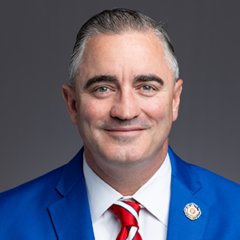
Report of the General President
Edward A. Kelly
General President
Pursuant to Article VI, Section 1 of the Constitution and By-Laws of the International Association of Fire Fighters, I am proud to submit this report of my official acts as General President since the close of the 57th IAFF Convention.
CANADIAN OPERATIONS
The IAFF’s influence has grown across Canada since our last Convention, resulting in tremendous gains for our members. At every level of government, politicians are looking to our union for expertise when it comes to the fire service and public safety.
In April 2026, Prime Minister Mark Carney hosted us in his office to discuss issues affecting Canadian fire fighters and paramedics. General Secretary-Treasurer Líma; District Vice Presidents Carter, LeBlanc, and Ross; Assistant to the General President Carmen Santoro; Ottawa Local 162 President Genna McMillan, and Neil McMillan of our Medical Assistance Program joined me for the meeting. The Prime Minister took an interest in the IAFF’s legislative priorities, particularly the urgent need to index Canada’s Memorial Grant Program. The one-time award has remained the same since 2018, despite inflation having risen by 25%. The Grant needs to be raised to $375,000 and be permanently indexed to inflation; Prime Minister Carney agreed.
A few months later, Parliament passed Bill C-14, which requires judges to treat assaults against on-duty fire fighters as an aggravating factor during sentencing. It was enacted into law in July 2026. Members across the country have shared their own experiences with violent patients, underlining the need for this legislation. The win was the result of sustained advocacy by IAFF affiliates and our Canadian Operations staff, who have kept the issue front and center with the media and politicians.
With wildfires continuing to ravage many parts of the country, the IAFF is working with the Government of Canada to ensure fire fighters are ready to respond. Our Responding to the Interface (RTI) program has trained more than 1,000 Canadian fire fighters to operate safely and effectively in wildland-urban interface fires – and we expect our federal partnership to continue. The IAFF also secured a three-year renewal of our HazMat/CBRNE grant. Demand for both programs is only growing, and we have called on the government to increase these grants in the future.
Thanks to MP Sherry Romanado’s Bill C-224, A National Framework on Cancers Linked to Firefighting, occupational cancer continues to be front and center in Canada. The IAFF is a key stakeholder in this work, leading efforts on cancer education and collaboration. We are also participating in consultations on the creation of a Canadian Firefighter Cancer Registry, which would help scientists and researchers better understand cancer in our ranks.
The IAFF’s success is encouraging fire fighters across the country to organize with our union. The Blood Tribe Emergency Services Association (Alberta) Local 5565 became the IAFF’s 200th Canadian Local – and the first to represent a First Nation. Quebec City fire fighters also voted in June 2026 to reaffiliate with the IAFF by an 88% margin.
The future is promising for Canada’s fire fighters and paramedics, and I’m grateful to our Canadian staff and DVPs for their commitment to our mission and members.
COMMUNICATIONS
The IAFF has transformed how it communicates with members about issues affecting their lives and careers. The results speak for themselves.
Since we gathered in Boston for our last Convention, IAFF.org has attracted 5.8 million visits – compared with about 1 million in 2022 and 2023. Our social media audiences have grown across every platform, with LinkedIn and Instagram seeing the largest gains.
Content focused on organizing, legislative advocacy, and retirement security generated some of our strongest engagement. Last year alone, likes, shares, and comments across IAFF social media increased 42%.
The IAFF also introduced new tools to help members stay informed. A legislative scorecard makes it easy to see how elected officials voted on IAFF priorities, while a new chatbot gives website visitors quick access to information about the union, our programs, and benefits.
We also created the IAFF Impact Report to give members a clear picture of what the union is doing on their behalf. It brings the work of every division together in one place – so every member can see the results we’re delivering and the value that comes with IAFF membership.
Communications training for affiliates also expanded. Thirty members from across the United States and Canada attended the first Advanced Communications Training Academy. It brought next-level instruction on messaging, media relations, digital strategy, and AI for members who had already completed the IAFF’s communications classes.
In 2025, the Communications Division completed over 1,000 projects – producing work that supports every aspect of our union. The division continues to expand its crisis communications support for affiliates, providing rapid assistance when issues arise.
We also added two new positions – a Political Communications Coordinator and a Technical Communications Coordinator – to align communications expertise with major areas of the IAFF’s work. These positions help ensure that members not only get the information they need, but that complex topics are communicated in ways that are timely, accurate, and easy to understand.
EVENTS MANAGEMENT
When I became General President, we made the decision to professionalize how the IAFF plans and produces its events. The results speak for themselves. Our events are drawing record attendance, and we’ve raised the standard for how members and guests experience this union. That means an intentional focus on everything, from the look of our spaces to the programming offered each day.
You can see that attention to detail in every IAFF event, from the Fallen Fire Fighter Memorial Ceremony to the new Strive for Excellence Summit. That approach takes planning and a team that understands the mission. IAFF events are all-hands efforts, and I’m grateful to everyone who plays a part in making them successful.
GENERAL COUNSEL
The IAFF’s legal team – led by General Counsel Peter Leff and his colleagues at Mooney, Green, Saindon, Murphy & Welch, P.C. – continues to defend the rights and protections of our members and affiliates. Canadian General Counsel Sean McManus does the same across the provinces.
Our Guardian Policy has saved jobs in both countries, and our Emergency Disputes Fund helps affiliates secure the legal representation they need when the stakes are highest.
Since our last Convention, the IAFF legal team has recovered more than $4 million for members. One of the most significant victories came in Kentucky, where a federal judge awarded more than $1 million to two Harrodsburg Local 5418 members who had been fired for exercising their free speech rights.
The IAFF has also worked to draw attention to the impacts of market manipulation in the fire apparatus industry. With fire engine prices climbing above $1 million and ladder trucks approaching $2.5 million, departments in both countries are keeping outdated and dangerous rigs on the streets long past the point they should have been replaced.
Behind the crisis are a handful of companies – purchased up by private equity firms – that now control two-thirds of the market. I testified before the U.S. Senate in September 2025 to call for an investigation into this public safety crisis. The IAFF’s work has led to multiple lawsuits challenging industry practices, and our General Counsel is providing input to these cities as their class-action cases move forward.
The bottom line is this: Companies cannot be allowed to put profits ahead of safety. The IAFF won’t stand for it, and this union will do everything it can to hold the industry accountable.
GOVERNMENT AFFAIRS & POLITICAL ACTION
Over the last 20 months, the IAFF has secured two of the greatest legislative victories in our 108-year history. Our work has helped return billions of dollars to retirees, extend survivor benefits to the families of fire fighters who die from occupational cancer, and secure permanent funding for the World Trade Center Health Program.
These are generational wins – and none of them were guaranteed. But our laser focus on fire fighter issues has allowed us to build relationships with politicians from both parties, and because of that, we’ve turned long-standing IAFF priorities into law.
As I’ve said before: We don’t have permanent friends. We don’t have permanent enemies. If a politician is with us on our issues, we’re with them. It’s all about delivering for our mission and our members. That’s it.
And the 2024 presidential election proved why that approach matters. Two years ago, as the Executive Board considered whether to make an endorsement for president, we went directly to both campaigns with one question: What will you do for fire fighters?
The Trump campaign gave us commitments on our issues – to support repeal of the WEP and GPO, work with us to pass the Honor Act, support an Emergency Response Standard, and protect the jobs of our federal brothers and sisters. The other campaign wouldn’t identify concrete commitments it could make to fire fighters.
Ultimately, the Executive Board voted to remain neutral in the presidential race. That decision has strengthened our ability to deliver for members.
When the federal government began restructuring agencies, we made sure our 16th District members were protected. Executive orders ensured that not one of our federal fire fighters was laid off – and not one lost collective bargaining rights. We also secured the first increase in the federal fire fighter uniform allowance in more than 20 years – from $800 to $1,500.
Since becoming General President, we’ve made repealing the Windfall Elimination Provision and Government Pension Offset a top priority. These penalties were wrong in 1984, and they remained wrong in 2024. Retired public employees should never have had their hard-earned Social Security benefits slashed because they chose a life of service.
Rally after rally, meeting after meeting, we pushed Congress to act. And we didn’t let up.
A successful discharge petition – only the seventh to succeed in 40 years – forced a vote on the floor of the U.S. House. That alone was historic. The legislation had been introduced in every Congress since 2005, but it had never received a vote.
Once it did, it passed with overwhelming, bipartisan support.
Then we turned to the Senate. Our Government Affairs team and I spent the final week of the 118th Congress camped out on Capitol Hill. We confirmed members who were a yes, lobbied members who were undecided, and made the case to those who were a no. President Donald Trump, yet to be sworn in for a second term, lent his support, too – helping whip votes for cloture and passage of the law.
Just after midnight on Dec. 21, 2024, it was official. The Senate voted 76-20 to repeal the WEP/GPO. After nearly 40 years, those penalties were eliminated.
Months later, we passed the Honoring Our Fallen Heroes Act with the same bipartisan approach.
The Honor Act was introduced by Democratic Sen. Amy Klobuchar and Republican Sen. Kevin Cramer in honor of Mike Paidar, a St. Paul, MN Local 21 member who died from acute myeloid leukemia in 2020. After Mike’s death, his wife, Julie, worked with the IAFF to add occupational cancer to the federal Public Safety Officers’ Benefits Program. She and other IAFF families came to Washington, met with lawmakers, and made the case for changing the law.
The IAFF worked both sides of the aisle and both chambers of Congress – from the Speaker of the House to Senate leadership – while making our case directly to the White House. And when members of the House demanded a pay-for, the Trump Administration identified $250 million to help secure its passage.
The law now recognizes occupational cancer as a line-of-duty death under the PSOB, making surviving families eligible for more than $461,000 in federal benefits.
As we approach the 25th anniversary of the September 11 terrorist attacks, we have delivered another long-standing priority: permanent funding for the World Trade Center Health Program. More than 450 members have died from WTC-related illnesses in the years since 9/11, and that number only continues to grow.
Credit is due to our brothers and sisters in New York City. UFA Local 94 and UFOA Local 854, who refused to let Washington forget what it owes the fire fighters and emergency medical workers who answered the call that day and in the weeks and months that followed.
In meetings with Health and Human Services Secretary Robert F. Kennedy Jr., I underscored the need for HHS to ensure this critical program was fully funded. He agreed. And now, 25 years later, there are no more funding cliffs. Our members will continue to receive the care they were promised.
And while we will never stop fighting for national collective bargaining rights, we’re not waiting on Washington. We’re going state by state and city by city to give more of our members a voice on the job – and we’re winning those battles in some of the toughest parts of the country.
Hurst, TX Local 4660 and Victoria, TX Local 3679 both won collective bargaining referendums. After years of tension with the city, Jackson, MS Local 87 backed John Horhn for mayor – with support from FIREPAC and the IAFF’s political program. Jackson’s fire fighters put their weight behind him. He won. And working with Local 87, the Professional Firefighters Association of Mississippi, and the IAFF, Mayor Horhn reached an agreement on the department’s first collectively bargained contract in decades.
And as we win more rights for fire fighters, we’re bringing more fire fighters into this union.
The IAFF has never been bigger than we are today. 367,861 members – the most in our history. We’ve grown by more than 18,000 members since we gathered in Boston, and nearly 50,000 since General Secretary-Treasurer Líma and I first took office.
HEALTH, SAFETY & MEDICINE
Health & Safety
The hazards of our job are constantly evolving. And one of the most important ways the IAFF protects its members is by making sure the standards, the research, and the medicine evolve with them.
That starts with practical, enforceable standards that make this dangerous job safer.
We’re closer than ever to seeing OSHA’s Emergency Response Standard become law. It would establish baseline requirements for staffing, training, apparatus readiness, and fire fighter health and safety.
The IAFF has testified on the importance of the standard and led a coalition across the fire service to make sure the final rule is as strong as possible. Because we know that when fire fighters are safer, the communities we took an oath to protect are safer, too.
Our work on safety standards goes well beyond OSHA. More than 175 IAFF members serve on standards committees across the United States and Canada, making sure fire fighters have a seat at the table when decisions are made about the equipment we use and the conditions we work in.
We’re taking on the fire services’ greatest threats, including occupational cancer.
After years of pushing for change – and refusing to take no for an answer – we secured major changes to the standards governing fire fighter gear. The new NFPA 1970 standard includes a Restricted Substances List banning PFAS, along with other protections the IAFF fought for, like the removal of the UV Light Test.
We also created a Manufacturer’s Code of Conduct for the companies making the gear our members depend on.
The terms are simple: Tell us the truth. And when you find a hazard in your product, bring it to us before we bring it to you.
Because our health and safety have to come before their bottom line.
As battery storage systems and electric vehicles become more common, we developed an Energy Hazard Guide to give members the information they need to respond safely.
And after a shipboard fire killed two Newark fire fighters, we took the lessons from the NTSB and Coast Guard investigations and turned them into new shipboard firefighting awareness training.
When we learn something that can make other fire fighters safer, we have an obligation to put those lessons to work.
Programs such as Fire Ground Survival, Peer Support, Fit to Thrive, and Responding to the Interface (RTI) continue to help members stay healthy and safe on the fireground.
In Houston, Texas, the IAFF piloted its Evidence-Based Fireground Operations program, putting the latest fireground research into practice under real-world conditions.
We’ve also developed new workplace violence prevention training to help affiliates protect fire fighters and paramedics facing violence on the job. And we’ve expanded behavioral health programs, strengthened peer support, and deployed teams following major incidents – including the aircraft crash in Washington, D.C.
Science & Research
We need reliable, independent science to understand the risks we face and what to do about them. For years, the fire service relied on research from the same companies that profited from us. The answers were coming from the people who had the most to gain, while we had the most to lose. That’s why I established the Chief Science Advisor position.
Led by Dr. Derek Urwin, the IAFF is conducting its own research and partnering with leading hospitals and universities across North America to expand what we know about fire fighter health and safety.
Testing with Duke University found high levels of brominated flame retardants in the first PFAS-free moisture barrier to reach the market. After we caught it, they removed it from the supply chain. We’re also studying what our members were exposed to during the Eaton and Palisades wildfires, the health risks of lithium-ion battery fires, and the effects wildfire smoke may have on reproductive health. The IAFF is also working with the Muscular Dystrophy Association to explore the link between firefighting, PFAS exposure, and ALS.
Medicine
The IAFF’s Medical Assistance Program has become one of the most effective tools we have to help members and families secure the medical and disability benefits they’ve earned.
Led by our Chief Medical Officer, Dr. Dan Whu, MD, MPH, the program brings medical expertise into cases involving cancer, cardiac disease, and other job-related illnesses. Since the program launched nearly five years ago, we’ve taken on more than 170 cases – and won almost all of them. Sometimes, they’re also precedent-setting.
Here’s just one of them.
Austin Local 975 member Suzanne LaFollette was diagnosed with stage four uterine cancer last year.
When she filed for workers’ compensation, her claim was denied because uterine cancer is not included on Texas’ list of presumptive occupational cancers.
More than 100 members of Local 975 attended her hearing, and the IAFF’s Medical Assistance Program went to work on her behalf. Dr. Whu testified in the case, presenting the medical evidence linking Suzanne’s cancer to her 19 years in the fire service. The judge ruled in Suzanne’s favor.
But Suzanne will tell you the significance of that decision goes beyond her own case. “Winning this case was not just important for me, but for the women who come after me,” she said. “I hope they will not have to fight workers’ compensation while they are fighting for their lives.”
And this work goes beyond individual cases. Dr. Whu has testified in more than a dozen states – and in British Columbia, Manitoba, and Ontario – to help pass presumptive laws recognizing occupational illnesses as job-related.
TECHNICAL ASSISTANCE & INFORMATION RESOURCES
When our affiliates are fighting for adequate staffing, TAIR gives them the data to prove what their departments need.
Since our last Convention, TAIR has completed more than 1,500 technical reports for affiliates across the United States and Canada. And we’re delivering those reports in record time.
About 1 in 5 IAFF Locals receive a TAIR report each year. They’re putting them to good use – for the safety of their community and our members.
In Fall River, Massachusetts, a TAIR study provided Local 1314 with the data it needed to defend four-person staffing – an issue that took on even greater urgency after the fatal fire at Gabriel House in July 2025.
That same kind of analysis is helping Los Angeles, CA Local 112 confront decades of underinvestment in the fire department.
TAIR put hard numbers behind what Local 112 members had been saying for years. Our analysis found that the Los Angeles Fire Department would need approximately 4,000 additional fire fighters – nearly double its current staffing – and more than 60 new stations to meet NFPA standards. Local 112 took that report and launched a ballot initiative to generate approximately $320 million per year for the LAFD. It goes before voters this November.
TAIR is also helping us build new pathways into the fire service. Since our last Convention, the IAFF created the first federally registered apprenticeship program for fire fighters in the United States. The program gives people interested in becoming fire fighters a clear path into the profession, and gives departments another tool to recruit and train the next generation.
We’re working with the Department of Labor to expand funding for the program, and Shreveport, Louisiana Local 514 will be among the first affiliates to put it to work.
TRAINING, EDUCATION & GRANTS
Since our last Convention, the IAFF has delivered more than 647,000 hours of training to our members.
We secured a $7 million grant from the U.S. Department of Energy – a 30% increase over past grants– to expand HazMat training for fire fighters working near nuclear facilities. And an $8 million grant from the National Institutes of Health – the largest grant in our union’s history – is helping us prepare members for emerging hazards. It’s funding new energy-response training and expanding resources like our Energy Hazard Guide.
That same grant is supporting a first-of-its-kind drone training program for the fire service. The drone is the new canary in the coal mine, scouting the hazards ahead for fire fighters. Our first class of pilots has graduated, and more training is coming.
But technology also comes with a caution. These tools are getting more advanced – and more costly. As they take up a larger share of fire department budgets, we have to make sure they don’t come at the expense of what’s truly important. Technology can make us safer. But it cannot replace a properly staffed, well-trained, well-equipped fire fighter. Because when someone’s life is on the line, that’s what will make the difference – not a drone overhead.
We’re also helping Locals bring federal dollars home. Since our last Convention, the Grants Division has reviewed and supported AFG and SAFER applications that have secured more than $359 million for departments represented by IAFF affiliates.
We’re also staying current and changing how we deliver education to our members.
This year, we held our inaugural Strive for Excellence Summit, bringing together the best of the IAFF’s training in one place. More than 2,000 members attended, with over 200 workshops to choose from. Half of those classes were brand new. And for the first time at an IAFF event, we offered 10 different hands-on training courses, led by some of the best and most talented instructors in the fire service. Members also had opportunities to earn continuing education units, college credit, certifications, and professional credentials.
By all accounts, the event was a success. Feedback from participants was overwhelmingly positive, and we’re already planning for 2027.
CONCLUSION
The IAFF is on the right trajectory. Complacency is not an option. Joined by GST Líma and the entire Executive Board, we will continue to think strategically and creatively with – with our sole focus being improving the lives of our members. We will continue to earn our place as THE strongest union in North America and the fire service’s leading voice on the planet.