
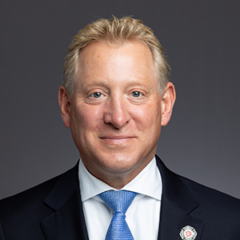
6th District Report
Mike Carter
6th District Vice President
It is my pleasure to present the report of the Sixth District for the 58th Convention of the International Association of Fire Fighters. This report summarizes the accomplishments, progress, and advocacy undertaken across British Columbia, Alberta, Saskatchewan, the Northwest Territories, and Yukon since our last Convention.
These achievements reflect the unwavering commitment of our affiliate leaders, members, IAFF staff, and provincial associations to strengthening our Union, protecting our members, and advancing the fire service profession.
In accordance with Article VI, Section 7 of the International Association of Fire Fighters Constitution & By-Laws, I respectfully submit this report of my activities as Sixth District Vice President to General President Edward A. Kelly, General Secretary-Treasurer Frank Líma, the IAFF Executive Board, and all officers and delegates assembled at the 58th Convention.
The Sixth District now proudly represents more than 12,000 members across one of the largest and most diverse geographic jurisdictions within the IAFF. Stretching from the Pacific Coast to the Prairies and into Canada’s North, our District encompasses fire fighters and paramedics serving communities ranging from major metropolitan centres to remote northern regions. Even with that diversity, our members remain united by a common purpose – to protect the public, support one another, and leave our profession stronger than we found it.
Throughout this reporting period, I attended every Executive Board meeting and represented the interests of our members at provincial conventions, affiliate meetings, educational conferences, political events, legislative sessions, bargaining meetings, arbitrations, and organizing campaigns.
Equally important has been the day-to-day work that often occurs behind the scenes, including providing guidance to affiliate leaders, supporting collective bargaining strategies, assisting with governance issues, coordinating IAFF resources, responding to legislative challenges, and ensuring our locals have the support necessary to succeed.
The strength of the Sixth District has never been defined solely by its size, but by the quality of its leadership. Every accomplishment highlighted in this report reflects the dedication of our affiliate officers, provincial associations, IAFF Field Service Representatives, Government Affairs staff, Legal Department, Communications staff, and the many subject matter experts who work tirelessly on behalf of our members. Together, their professionalism and commitment continue to make the Sixth District one of the strongest and most respected districts within the IAFF.
One of the greatest measures of a healthy organization is its continued growth. Since our last Convention, the Sixth District has proudly welcomed three new affiliates into the IAFF family.
The Central Paramedics Association became IAFF Local 5482, expanding our representation of professional paramedics and strengthening our voice on behalf of emergency medical services.
The Blood Tribe Emergency Services Association proudly affiliated as IAFF Local 5565. Their decision to join the IAFF represents an important milestone for emergency responders serving the Blood Tribe and reinforces our commitment to supporting Indigenous communities and fire fighters throughout Canada. We also welcomed the North Saanich Fire Fighters Association as IAFF Local 5509, further strengthening our presence in British Columbia and continuing the steady growth of organized professional fire fighters across the province.
These affiliations represent much more than additional membership numbers. Each new local strengthens the IAFF’s collective influence, expands our ability to advocate politically, and ensures more fire fighters and paramedics have access to the education, representation, legal support, bargaining expertise, and health and safety programs that define our International Union.
The continued growth of the Sixth District is a direct reflection of the outstanding work being performed by affiliate leaders who understand the value of solidarity and recognize that fire fighters achieve far more together than they ever could alone.
The past two years have presented significant challenges to the delivery of emergency services throughout the Sixth District. Local leaders repeatedly demonstrated that when fire fighters stand together with their communities, positive outcomes can be achieved.
Perhaps no example better illustrates this than the successful campaign led by Red Deer Local 1190 to defeat the City’s proposed Dynamic Staffing model. Under the proposal, fire apparatus would have been routinely browned out or removed from service based on daily staffing levels, reducing emergency response capacity and increasing risk to both fire fighters and the public.
Local 1190 mounted an impressive campaign combining public education, political engagement, media outreach, technical analysis, and strong member solidarity. Their efforts led the City to abandon its proposed Dynamic Staffing model and maintain safer staffing levels. Their success has become an example for affiliates across North America facing similar staffing reduction proposals.
The Sixth District also confronted one of the most significant political challenges in Alberta in recent years. Proposed reductions to provincial funding for integrated fire-based EMS systems threatened approximately 300 IAFF positions across Alberta. These proposed changes would have fundamentally altered emergency medical response in numerous communities while reducing professional fire fighter staffing.
Working alongside the IAFF Alberta, affiliate leaders, municipal officials, community stakeholders, and IAFF Government Affairs staff, we coordinated an extensive advocacy campaign that clearly demonstrated the operational and public safety consequences of these proposed reductions. Through sustained advocacy and collective action, these positions were ultimately protected. This was a major victory for our members and for the citizens who depend upon highly trained professional fire fighters and paramedics every day.
Collective bargaining continued to dominate much of our work throughout the reporting period. While many affiliates successfully negotiated freely bargained agreements that improved wages, staffing, benefits, and working conditions, others were required to defend their members through mediation, interest arbitration, and legal proceedings.
Across every bargaining table, the IAFF continued to provide exceptional support through financial analysis, bargaining strategy, legal assistance, communications resources, research, and political advocacy. These services remain one of the greatest strengths of our International and continue to produce meaningful outcomes for affiliates regardless of their size.
Protecting fire fighter health remains one of the defining priorities of both the IAFF and the Sixth District.
British Columbia established a significant benchmark for the health and safety of fire fighters through two important legislative initiatives. Amendments to the BC Workers Compensation Act added eight new cancers to the province’s presumptive coverage, increasing the total to twenty-six. Shortly after, the BC Legislative Assembly unanimously passed the Firefighters’ Health Act, which mandates a preventive healthcare plan. This includes a comprehensive screening program within 12 months, early cancer detection, health evaluations, exposure tracking, and a five-season equity threshold for wildland crews, with a five-year legislative review included.
Throughout the Northwest Territories, important legislative improvements were achieved to strengthen Workers’ Compensation protections for fire fighters. These protections now lead the country with a two-year latency period, 28 presumptive cancers, and improved cardiac coverage. These changes continue the national movement toward recognizing the unique occupational hazards associated with firefighting while ensuring members receive fair treatment when injured or diagnosed with occupational disease.
Nationally, the Sixth District has been proud to help lead the implementation of the Canadian Firefighter Cancer Prevention Framework. This landmark initiative brings together governments, researchers, fire service organizations, labour representatives, and health experts to coordinate Canada’s approach to fire fighter cancer prevention.
Equally significant has been the continued development of the Canadian Firefighter Cancer Registry. Working with Statistics Canada and numerous national partners, important progress has been made toward creating the first comprehensive national fire fighter registry capable of linking occupational exposure information with long-term cancer outcomes.
Once completed, the registry will transform fire fighter cancer research in Canada by improving data collection, supporting evidence-based policy decisions, strengthening presumptive legislation, and identifying emerging occupational risks earlier than ever before.
This work represents one of the most important long-term health initiatives our profession has undertaken and will benefit fire fighters for generations to come.
Throughout the reporting period, the Sixth District remained actively engaged in efforts to strengthen Criminal Code protections for fire fighters and paramedics. Violence directed toward first responders continues to increase across Canada, and stronger legal consequences are necessary to recognize and deter assaults committed against emergency responders performing their duties.
The District also worked closely with national and provincial partners in opposing proposed single-egress building code changes. While intended to address housing challenges, these proposals introduced significant concerns regarding occupant safety, fire fighter operations, evacuation, and fire suppression. As a result, the IAFF successfully ensured that fire fighter safety remained central to the national conversation surrounding these proposed code amendments.
In Saskatchewan, we have continued working with the Saskatchewan Professional Fire Fighters and government officials to improve access to interest arbitration for smaller IAFF affiliates.
Many smaller municipalities currently lack meaningful access to effective dispute-resolution processes, creating unnecessary barriers to achieving fair collective agreements. Our objective remains simple: every IAFF local, regardless of size, deserves access to a fair and balanced bargaining system that recognizes the essential services our members provide.
Over the past two years, the Sixth District significantly expanded IAFF educational programming throughout the region. Fire Ground Survival, Peer Support, Fire Ops, Human Relations, leadership development, and numerous additional educational opportunities were delivered across British Columbia, Alberta, Saskatchewan, Yukon, and the Northwest Territories.
Particularly noteworthy has been the continued success of the federally funded Responding to the Interface (RTI) program.
As climate change continues to increase the frequency and severity of wildland-urban interface incidents, fire fighters require specialized operational knowledge unlike anything previously experienced. Through federal funding and outstanding instructors, RTI has become one of the IAFF’s premier educational programs and continues to expand throughout Canada.
Equally important has been the continued development of peer support teams, behavioural health resources, and leadership education, equipping affiliate leaders with the tools necessary to support members both personally and professionally.
Innovation has also become a defining characteristic of the Sixth District. Working collaboratively with IAFF Local 255, the Calgary Fire Department, and municipal leadership, we established Canada’s first municipal Fire Committee.
This groundbreaking initiative creates an ongoing forum where labour and management can jointly examine strategic issues affecting the fire service, improve communication, identify emerging challenges, and develop collaborative solutions before issues become larger problems.
The committee represents a new model of labour-management collaboration that has the potential to influence municipalities across Canada and further demonstrates that strong labour relationships benefit fire fighters, employers, and the public alike.
Fire fighters continue to face increasing operational demands, expanding service expectations, growing mental health challenges, occupational cancer risks, recruitment pressures, staffing concerns, and evolving political environments.
The Sixth District will continue focusing on strengthening collective bargaining, expanding IAFF educational programming, growing our membership, advancing fire fighter health initiatives, protecting safe staffing, improving legislation, and ensuring every affiliate has access to the resources necessary to succeed. The challenges before us are significant, but so too is the strength of our Union.
None of the accomplishments contained in this report would have been possible without the outstanding leadership demonstrated throughout the Sixth District. I want to sincerely thank every affiliate president, executive board member, bargaining committee, political action volunteer, shop steward, instructor, peer support member, and fire fighter who has stepped forward to improve our profession. Your dedication continues to inspire confidence in the future of the IAFF.
I also wish to recognize outgoing District Field Service Representative Brian Catinus for his exceptional years of service to the Sixth District. Brian’s professionalism, knowledge, mentorship, and unwavering commitment have strengthened countless affiliates throughout Western Canada and the North. On behalf of every local you have assisted, thank you for your remarkable contributions to our Union.
Finally, we remember the brothers and sisters we have lost since our last Convention. Their dedication, sacrifice, and commitment to serving their communities will never be forgotten. We honour their memory by continuing the work they believed in—making our profession safer, stronger, and more united for those who will follow.
On behalf of the Sixth District, I extend my sincere appreciation to General President Edward A. Kelly, General Secretary-Treasurer Frank Líma, the IAFF Executive Board, our outstanding IAFF staff, provincial associations, and every affiliate leader throughout British Columbia, Alberta, Saskatchewan, Yukon, and the Northwest Territories.
The accomplishments outlined in this report demonstrate what is possible when we stand together with purpose, professionalism, and solidarity. I remain incredibly proud to serve as your Sixth District Vice President and look forward to continuing our work together as we build an even stronger future for our members, our families, and the communities we proudly serve.