
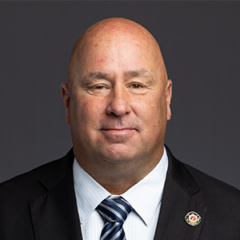
9th District Report
Michael Frainier
9th District Vice President
Pursuant to Article VI, Section 7 of the Constitution & By-Laws of the International Association of Fire Fighters, I respectfully submit this report of my activities as Vice President of the 9th District. This report is presented to General President Edward A. Kelly, General Secretary-Treasurer Frank V. Líma, the IAFF Executive Board, the IAFF Trustees, and the delegates and alternates attending the 58th Convention of the International Association of Fire Fighters in Arlington, Texas, August 10–14, 2026.
The 9th District welcomes all Convention delegates, alternates, IAFF staff, vendors, and families who have traveled to Arlington, Texas, for the 58th Biennial IAFF Convention. Together, we have an opportunity to honor our history, bring fresh perspective to the issues shaping our profession, and support this convention’s theme: “All In.”
I am honored to serve as the IAFF 9th District Vice President. Since I was elected and sworn in on April 10, 2021, I have traveled throughout the District on behalf of its 177 locals, five state organizations, and more than 17,300 members.
I have attended all IAFF conferences, including the IAFF Strive for Excellence Conference, IAFF Legislative Conference, and Instructor Development Conference. I have also participated in 10 Executive Board meetings since our last Convention. As Chair of the IAFF Fallen Fire Fighter Memorial Committee, I have had the honor of serving as master of ceremonies for the IAFF Memorial Ceremony each September in Colorado Springs, Colorado.
Education and training remain top priorities for both the IAFF and the 9th District. In 2026, four instructors and more than 150 members attended the first IAFF Strive for Excellence conference in Las Vegas, Nevada. In June 2025, the 9th District hosted the IAFF 9th District PEP and Leadership Forum in Las Vegas, Nevada, and we look forward to continuing the forum in 2027. In 2025, six members and in 2026, seven members attended the IAFF Communications and Political Training Academies. The Colorado, Nevada, Oregon, Utah, and Wyoming state associations continue to offer educational events with IAFF support.
As we move the IAFF forward, we must never forget the brothers and sisters who made the ultimate sacrifice in service to their communities. We also have a responsibility to confront the most urgent challenges facing our members today.
The IAFF has led the fight to address cancer in the fire service and will continue advancing solutions to reduce its impact. Expanding the IAFF Health and Safety Division and appointing an IAFF Chief Medical Director strengthen our voice as we work with NFPA, OSHA, and lawmakers on the standards and policies that affect firefighter safety.
The IAFF has led the fight to address cancer in the fire service and will continue advancing solutions to reduce its impact. Expanding the IAFF Health and Safety Division and appointing an IAFF Chief Medical Director strengthen our voice as we work with NFPA, OSHA, and lawmakers on the standards and policies that affect firefighter safety.
SB-25 update — IAFF Colorado successfully passed legislation updating the voting criteria under SB-25, Colorado’s Firefighter Safety Act. The bill passed both chambers and was signed into law.
Presumptive cancer bill veto — Despite bipartisan support in both the House and Senate, Governor Jared Polis vetoed the presumptive firefighter cancer bill. This was a significant setback for Colorado firefighters, as the bill would have provided important protection for members battling occupational cancers.
Looking ahead, Governor Polis will leave office at the end of his term, and IAFF Colorado has endorsed U.S. Senator Michael Bennet for governor. CPFF has met with Senator Bennet in recent months and has had productive conversations about the issues most important to Colorado fire fighters. The IAFF Colorado Foundation continues to grow at a remarkable pace. Over the past year, the Foundation’s assets have increased by more than $2 million. These resources provide critical support to fire fighters and their families across Colorado during times of tragedy, serious illness, and other significant hardships.
Nevada
In Carson City, PFFN secured important protections for members, including increased annual screenings for fire fighters, industrial insurance reforms that benefit workers across Nevada, and improved access to doctors for heart and lung disease so members can receive the treatment they need. PFFN also secured confidentiality protections for personal information, a goal it had pursued unsuccessfully in 2019.
When it mattered most during SB7, the membership stepped up. After the governor initially opposed the bill, members mobilized quickly. Calls were made to IAFF General President Edward A. Kelly, IAFF 9th District Vice President Michael Frainier, and Scott Mullins to engage key relationships and deliver a message to the governor. Additional outreach followed with the governor’s policy and political teams, and IAFF’s presence and engagement helped carry the bill across the finish line.
The passage was not the end of the fight. The bill is now facing a constitutional challenge, and the effort to defend it continues. Because of the strength of the membership, PFFN is positioned to continue that defense and prevail.
PFFN also recognizes that its influence extends beyond the state level. Working alongside the International Association of Fire Fighters, it has advanced federal priorities including reform of the Windfall Elimination Provision, strengthening the Public Safety Officers’ Benefits Program, and tax relief for overtime.
Federal grants remain another critical part of that work. Programs that support staffing, equipment, and training directly affect fire fighters’ ability to serve safely and effectively. Those resources come from sustained relationships, consistent advocacy, and ensuring the fire service has a strong voice at every level of government.
That is why political engagement matters. PFFN supports leaders who stand with fire fighters on benefits, safety, and support for families. Its endorsements are earned and grounded in protecting the profession and the people who serve in it.
The future will depend on what comes next. That means identifying, mentoring, and developing the next generation of leaders who will step forward, carry the mission, and continue building the organization’s strength.
Oregon
2025 Long Session
A PFAS resolution was adopted to ensure the legislature acts once PFAS-free turnout gear becomes available. The state secured $2.2 million for the apprentice program. Funding was approved for fire stations in Gresham and McMinnville. McMinnville passed a measure to separate from the city and establish a stand-alone fire district. In rulemaking, Oregon coordinated PERS (retirement) and workers’ compensation so that when a work-related claim is accepted by workers’ compensation, PERS must also recognize it under its rules, allowing members to receive PERS benefits automatically.
2026 Short Session
2026 short session focused on quick budget and policy updates. Working alongside IBEW, Oregon helped stop the balcony solar proposals. The state kept the federal tax break provisions aligned with H.R. 1, including the no-tax-on-overtime provision. Apprenticeship funding was preserved. Legislation related to CFR moved forward.
Looking Ahead to 2027
2027 Long Session
Oregon plans to pursue an increased retirement multiplier, including DROP, full cancer coverage, and funding for body scans and other cancer screening measures.
Utah
During the 2025 General Session, Utah Fire Fighters’ time was dominated by efforts to overturn the anti-labor HB 267S, which passed during the 2025 General Session. This bill sought to ban collective bargaining for public sector unions. Public-sector unions successfully met the referendum requirements to place the measure before voters in November 2026. In response, the governor called a special session on December 9, 2025, to repeal HB 267SO1. The repeal passed, so the measure will not appear on this November’s ballot.
While the repeal was pending, all parties agreed to a one-year ceasefire on labor legislation. A labor work group made up of union representatives and legislators is scheduled to begin meeting the week of June 15, 2026, to discuss potential updates to Utah labor law. Jack Tidrow will serve on the workgroup. Its priorities include expanding collective bargaining rights for labor and revitalizing the Utah Labor Board.
During the 2026 General Session, Utah passed eleven of its priority bills and successfully amended SB 229 (State Employee Benefits) to make it acceptable.
Priority Passed Bills
- HB 79 — Reinstated immunity protections to the original 1985 date. This was Utah’s top legislative priority in the last session and may serve as a model for other states facing similar proposals.
- HB 416SO5 — Established a fire fighter cancer trust fund and board of trustees, with $6 million in state seed funding.
- HB 338SO3 — Continued state funding for behavioral health services for fire fighters and police officers. In the final hour of the session, the bill was folded into HB 416SO5 to ensure passage.
Utah also launched a cooperative effort with the Major League Baseball Alumni Association and the Major League Baseball Commissioner’s Office to promote behavioral health awareness, including peer support and resiliency. A kickoff event on June 13 featured former MLB players coaching fire fighters, police officers, and military personnel, followed by exhibition games in South Jordan.
Wyoming
Enclosed is a brief Legislative Report from Wyoming for 2026. Wyoming has two different sessions of its Legislature over the course of a term. The odd years are the General Session. Which is forty (40) days long. The even years are the Budget Session. Which is twenty (20) days long. Each session sees approximately 400 bills. The budget session has a two-thirds vote threshold to introduce a non-budget bill.
2026 was a Budget Session. The FFFWY had several concerning bills.
- HB-006 Unemployment insurance coverage period and reporting. FFFWY opposed this bill. This bill was a Labor Committee Bill in 2026. It was a repeat bill from past sessions. The bill would reduce the amount of unemployment benefits from 26 weeks to 20 weeks. HB-006 failed introduction in the House.
- HB-0034 Fire fighters retirement plans. This bill reclassified Wyoming State Forestry Wildland fire fighters as fire fighters and placed ten in the Wyoming State Air Guard Firefighter pension plan. The plan would provide retirement benefits to wildland fire fighters on similar career timelines and municipal fire departments. It would further give a very small pension plan more members contributing to the pension. (Wyoming State Firefighters are represented by the Wyoming Public Employees Association) The FFFWY supported this bill. HB-34 was signed into law.
- HB-0035 Fire fighters paid leave and hazard pay. This bill improves pay and benefits for Wyoming’s State Wildland Firefighters. The FFFWY supported this bill. This bill was signed into law.
- HB-36 Forestry Division Wildfire Modules. This bill improved resources for WY Forestry for Wildfire suppression efforts. The FFFWY supported this bill. HB-36 passed into law.
- HB-131 Government membership and cooperation with associations. This bill would forbid government employees from joining associations that lobby the state legislature. FFFWY opposed the bill. HB-131 failed introduction 27-34-1.
- HB-144 Fire Protection districts mill levies- amendments. This bill would have allowed the Fire District to increase Mil levies to 10%. The funding was to counter the 25% deduction in residential property tax in 2025. FFFWY supported the bill. The bill was not heard in the Committee of the Whole.
- HB-162 Property tax exemption-first responders. The bill would reduce property tax for fire fighters. The FFFWY supported the bill. HB-162 was not considered for introduction.
- HB-178 Public union-transparency and dues withdrawal limitations. The bill would have removed paycheck deductions and removed the union’s use of public facilities. Fire fighters with CBAs were exempted from the bill. The Senate tried to amend fire fighters back in and failed. The FFFWY opposed the bill. Governor Gordon vetoed HB-178.
- SF-004 Medicaid rate increases-EMS services. The bill improves funding for Wyoming EMS service. FFFWY supported the bill. SF-4 passed.
- The State budget had amendments that would have provided Wyoming Fire Fighters with a cost-of-living adjustment on their pension. The amendments failed in conference committee.
A special thanks from the 9th District to the IAFF staff and the brothers and sisters of Arlington, Texas Local 1329 for all their support in hosting the IAFF 58th Biennial Convention!